
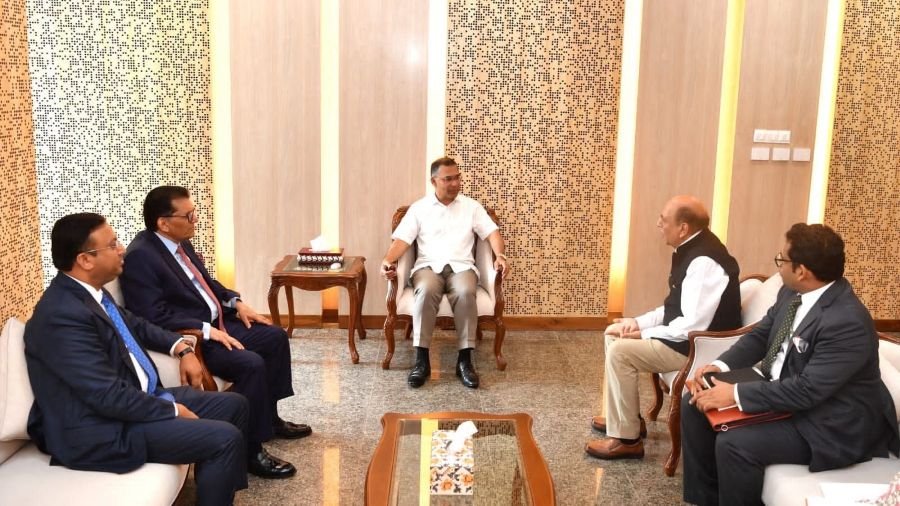
Picture Credit : @bdbnp78/X : Indian High Commissioner to Bangladesh Dinesh Trivedi paid a courtesy call on BNP Chairman and Honorable Prime Minister Tarique Rahman.
India is committed in maintaining stable and collaborative neighbourly relations, emphasising that its diplomatic engagement with Bangladesh remains rooted in a positive, people-centric vision aimed at mutual growth and regional development. However, the extradition issue has emerged as a major irritant in India-Bangladesh ties, which deteriorated sharply following Hasina’s ouster. An initial formal extradition request was submitted in December 2024 by the interim administration, followed by repeated calls from the administration of Prime Minister Tarique Rahman, which assumed office after the February 2026 general elections. Meanwhile, the Bangladeshi government has repeatedly raised the issue on different occasions.
To this, the Indian authorities have stated that the former Bangladeshi prime minister Sheikh Hasina’s arrival in New Delhi two years ago was “unexpected”, emphasising that the Indian military played no role in flight arrangements. The Indian High Commissioner to Bangladesh, Dinesh Trivedi stated, “Hasinaji was not brought to India by the Indian Air Force or the Indian Army.” He further noted, “It so happened because of the tragic circumstances in Bangladesh during that time. We hope and pray that should never happen, where innocent people get killed, doesn’t matter in which part of the world.” Trivedi noted that Indian authorities were caught unawares by the sudden development. “The military aircraft came to India… India was not prepared. I was watching on television, and the scroll was coming that she was going to some other country. At that point, Hasinaji was still the prime minister of Bangladesh. We had hardly any choice on that. It was our duty as a neighbour to accept the reality of life. Because situations are such that at times you are not prepared for such.” “What was our [India’s] choice?” Trivedi asked, noting that withholding “landing permission” could have fundamentally altered the evolving situation. He pointed out that both nations function as vibrant democracies, observing that the respective “legal systems” are actively examining matters concerning bilateral legal procedures.
Bangladesh expects India to expedite the extradition of deposed prime minister Sheikh Hasina, saying that besides the legal process, “political intent” was also necessary for her return. Hasina, 79, has been living in India since fleeing Dhaka on August 5, 2024, after a student-led agitation, dubbed the July Uprising, toppled her Awami League government. A special tribunal later tried Hasina in absentia and sentenced her to death over the crackdown on the protests. Hasina and her supporters have described it as a “kangaroo court”. The Muhammad Yunus-led interim government sought her extradition through a diplomatic note, while India has maintained that the request is being examined in line with established processes. Hasina, meanwhile, has said she intends to return to Bangladesh voluntarily by December to face the legal process.
The tension between the two nations were apparent when Rahman did not attend the BRICS summit held recently in New Delhi. India had invited Rahman to attend the summit in his capacity as chair of the Bay of Bengal Initiative for Multi-Sectoral Technical and Economic Cooperation (BIMSTEC), rather than to Rahman personally. The Prime Minister opted to skip the event ahead of his scheduled departure for the 81st UN General Assembly in New York. The invitation is separate from an earlier bilateral invitation extended to Rahman to visit India.
To reset it’s ties with Bangladesh, India has to have a steady strategic posture in the neighbourhood, prioritising sustained economic integration, infrastructural connectivity, and diplomatic stability across shared borders of 4,096 kilometre which remains a critical field for security and trade. Though, Rahman is keen to visit India at the earliest, but concerns remain over what concrete takeaways or achievements he would be able to present to his domestic audience following a visit to Delhi.
The extradition file remains a legal and political hurdle for both administrations. Until New Delhi provides a clear response regarding a date or a format for engagement, the call for a reset remains a policy goal rather than an established reality.