
Picture Credit : ( PTV/ANI)
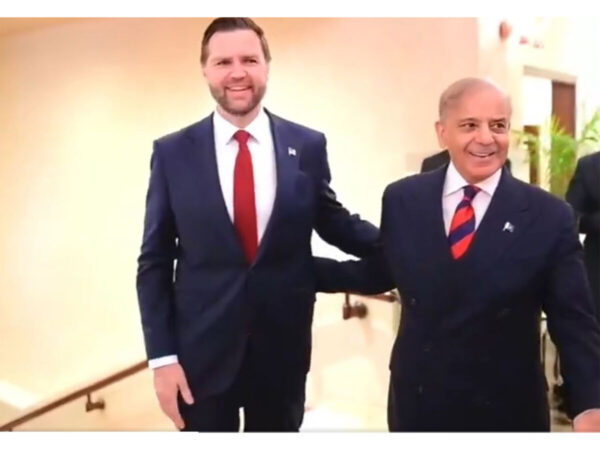
US Vice President JD Vance meets Pakistan PM Sharif in Islamabad
The geopolitical landscape of West Asia has taken an unexpected turn with Pakistan emerging as a key diplomatic broker in the 2026 Iran-US conflict, while India faces a strategic crossroads in response to Pakistan’s new role, necessitating a nuanced approach that prioritizes regional stability. The new scenario is marked by shifting alliances and new diplomatic roles. India must tread with maturity, advocating for peace regardless of the mediator’s identity. The overarching goal is to ensure stability and security in the region, reinforcing India’s identity as a responsible global power.
Pakistan’s approach as mediator is simply to stay visible, and claim relevance. The outcome of the talks is secondary. India, by contrast, has perfected the art of staying neutral. Its official position has been a predictable call for “dialogue and diplomacy” and de-escalation – safe, sterile, entirely risk-free. It has repeatedly – and somewhat pedestrianly declared that war is not an option, but deliberately avoided taking sides, avoiding mediation and even the appearance of activism. India’s External Affairs Minister S. Jaishankar went a step ahead in declaring that India is “not a go-between country” like Pakistan.
India’s strategy is of balance: balancing ties with Israel and Iran, balancing relations with the US and Gulf. Consequently, the result is a carefully hedged posture that forfeits initiative. India’s caution is not irrational, as it faces deeper structural stakes: energy dependence on Iran and the wider Gulf states, critical defence ties with Israel and strategic alignment with the US.
However, critics within India have grudgingly acknowledged that Islamabad’s diplomatic engagement and narrative management in the US-Israel-Iran crisis have been notably bold and proactive – qualities that have enabled it to seize the diplomatic initiative. Yet, what remains conspicuous is not Pakistan’s overreach, but India’s absence from the field.
India’s intent seems clear: preserve strategic ambiguity, avoid alienating partners, and hedge against uncertainty. Yet this studied restraint often comes at the cost of visibility and influence. By remaining on the margins at critical moments, India risks being perceived not as a stabilising power, but as a reluctant one – absent in initiatives when the stakes are high.
Meanwhile, being the mediator does not guarantee Pakistan success in hosting the US-Iran peace talks: its mediation may well fail, and its relevance may prove fleeting, Pakistan has displayed that it continues to try and doggedly game the house, playing for influence even when the odds are hugely uncertain. India, by contrast, remains at the table but largely unwilling to bet – carefully guarding its chips while others shape the game. Such caution often leaves it reacting to outcomes rather than influencing them.