
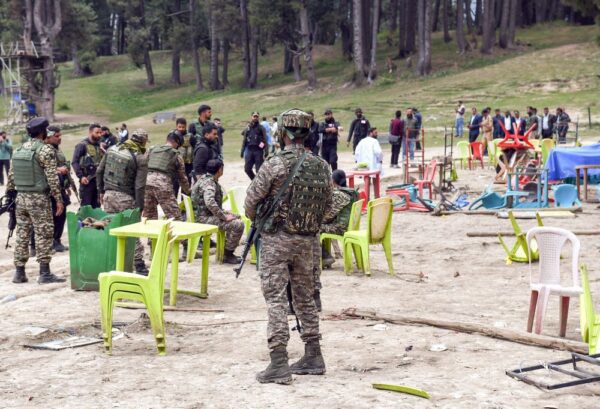
File Picture : ANI/X
It was a regular bright, sunny day for the tourists visiting Pahalgam enjoying the nature’s beauty when suddenly a group of armed terrorists attacked innocent civilians at the Baisaran meadow, leaving 26 dead. The terrorists carried out indiscriminate firing at people who were present there revelling on the open grasslands. Worse, the terrorists first asked for their respective religion and then killed them incessantly. Pahalgam now stand silent waiting to welcome back the tourists once again. The attack has ravaged the livelihoods of the locals, mainly dependent on tourism.
India took a number of diplomatic steps resulting in nearly severing ties with Pakistan. In a first, India held the 1960 Indus Water Treaty in abeyance, asserting that “blood and water cannot flow together” until support for cross-border terrorism ceases. The integrated check-post at Attari-Wagah was closed immediately, and all bilateral trade with Pakistan was suspended. In an effort to put maximum pressure on Pakistan, New Delhi also declared Pakistan’s military, naval, and air advisors, who were posted at their diplomatic mission in India, as persona non grata, even as the total staff strength of the High Commission was reduced from 55 to 30. In addition to this, India also revoked the visas of Pakistani nationals and suspended the SAARC Visa Exemption Scheme for them. ‘Operation Sindoor’ was to follow as a kinetic response to the heinous attack.
On May 7 when India went in for a major military retaliation codenamed ‘Operation Sindoor’ under which precision airstrikes were carried out by the Indian Air Force using Rafale jets equipped with SCALP missiles and HAMMER bombs in order to destroy nine major terror launchpads and infrastructure across the border in Pakistan and Pakistan-occupied Jammu and Kashmir (PoJK). Over 100 terrorists were reportedly killed in these strikes, including high-value commanders such as Yusuf Azhar and Abdul Malik Rauf.
Prime Minister Narendra Modi granted the armed forces full operational freedom to decide the timing and targets of the response. A subsequent ground operation, Operation Mahadev, was conducted by the Army, CRPF, and J&K Police to track and kill the specific perpetrators involved in the Pahalgam massacre. By July 2025, all three primary attackers were apparently neutralised.
However, India found itself grappling with a complex web of diplomatic relationships forcing New Delhi to reassess its alliances, particularly with key strategic partners like the United States. In the light of Operation Sindoor, India realised that such a stance has not translated into practical partnerships but only transactional. Not only did the United States seem to get closer to Pakistan, especially to its Army Chief Asim Munir, who got elevated to the rank of Field Marshal, but New Delhi’s rambunctious efforts to have some of its key allies explicitly name Pakistan as the sponsor of terrorism went in vain. And in a latest, Pakistan saw itself at the pivot point globally acting as a mediator between the US and Iran.
In the aftermath of the Pahalgam terror attack and Operation Sindoor, India dispatched seven all-party parliamentary delegations to conduct an extensive global diplomatic outreach. These delegations were tasked with conveying a unified national message of “zero tolerance against terrorism” and exposing cross-border support for terror infrastructure. There were a total of 59 participants, including sitting MPs, former ministers, and veteran diplomats. In order to give it a bipartisan look, the government chose 39 members from the ruling National Democratic Alliance (NDA) and 20 from non-NDA parties to project a bipartisan national consensus. The teams travelled to 33 countries and the European Union (EU) headquarters in Brussels, covering North America, South America, Europe, Africa, and Asia. Somehow, it seems the message has lost it’s meaning, since the world has now moved on from India-Pakistan to other countries creating much unrest and potential economic disruptions to keep the world guessing what next?