
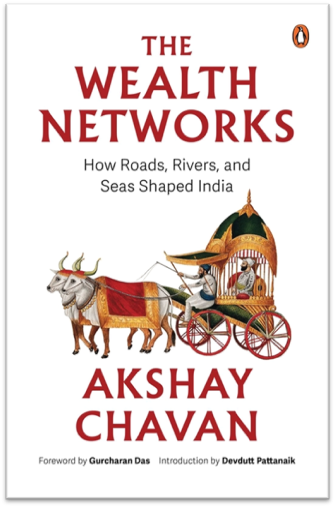
The Wealth Networks: How Roads, Rivers and Seas Shaped India by Akshay Chavan rethinks Indian history through the movement of wealth across routes of trade, pilgrimage and power. With a foreword by Gurcharan Das and an introduction by Devdutt Pattanaik, the book argues that the networks connecting roads, rivers and seas have long shaped the subcontinent’s economic and political life.
he book is positioned explicitly as “not a conventional history” but as “a different way of seeing,” tracing “the movement of wealth across roads, rivers and seas” and the patterns that continue to shape India today.
That argument feels particularly urgent now. When one narrow maritime corridor can unsettle global markets and affect household budgets thousands of miles away, the relevance of geography is difficult to ignore. Chavan’s central idea is that these networks are not new; they have always existed. The same logic that once made certain river valleys, ports, and cities important still shapes where power lies and where systems remain vulnerable today.
The book explores a number of questions at the heart of Indian history: Why was Chittor attacked again and again? Why were places such as Khajuraho and Ajanta built far from today’s major cities? Where did the enormous wealth of temple centres such as Somnath and Tirupati come from? Why did the British annex Jhansi? It argues that these were not isolated events, but the result of deeper patterns of wealth flow and geography.
Spanning cities, ports, and pilgrimage towns, The Wealth Networks connects geography, commerce, and society into a single narrative. The result is a history of India that is less about dynasties and battles, and more about movement: who controlled routes, who gained from trade, and how these flows shaped a civilization.
Chavan brings unusual range to the subject. After working in digital media for a decade, he founded and led Live History India, one of the country’s early digital platforms focused on history and culture, and has written more than 200 articles on India’s social, economic and cultural past. He is currently head of Pratiti Foundation.
The book also arrives with significant intellectual endorsements. Gurcharan Das has written the foreword and Devdutt Pattanaik the introduction. Historians and writers have described it as “ambitious, enlightening and authoritative,” “a refreshingly new prism” for viewing India’s past, and “a revelatory work” that reshapes how the subcontinent’s history is understood.
For editors and producers looking to connect the news cycle to deeper structural questions, The Wealth Networks offers a timely intervention: a way to understand why geography keeps returning to the centre of public life, and why the struggle over routes, resources and chokepoints is never just about the present.