
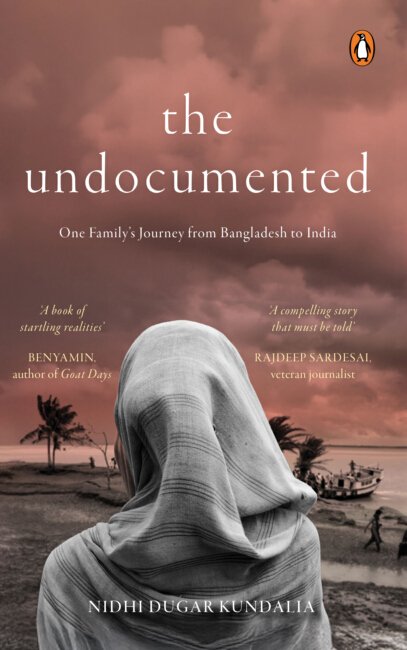
The Undocumented: One Family’s Journey from Bangladesh to India by Nidhi Dugar Kundalia
Bengal’s borderlands are again crowded with fear—with reports describing holding centres, a “detect, delete and deport” push, and thousands of undocumented migrants sent to Bangladesh or awaiting deportation. Into this charged landscape comes journalist Nidhi Dugar Kundalia’s new work of narrative nonfiction. The Undocumented follows Safrat, who becomes Sapna by day, and her children, Nur and Nabeel, as they flee the cyclone-ravaged Sundarbans of Bangladesh, slip into India, and rebuild a life inside Kolkata’s informal economy: false names, rented floors in slums, unregistered labour, and papers that don’t exist. But beneath that urgency sits a human book of nerve endings: a mother scrubbing sindoor off her scalp before a stranger’s door opens; a daughter who comes of age in the slum alleys; a son learning, far too young, the narrow and dangerous routes available to boys in the basti.
Drawn from thirteen years of fieldwork and over 200 hours of interviews, the narrative moves through Cyclone Aila, the salt and tiger bitten ecology of the Sundarbans, river and land trafficking routes, detention, ghettoization and the daily economy of a Kolkata slum — but its great subject is the inner weather of survival. Here, the urgent is never abstract: it is a birth certificate that does not exist, a hospital that will not release a body, a neighbour who must hide her Muslim name to wash utensils in a flat, a child whose hunger is numbed by glue fumes, a bowl of crab curry going cold while the police take boys away. Kundalia does not write the migrant as a number, threat or pity-object; she writes the migrant as weather, hunger, motherhood, memory, shame, skill, anger, prayer and above all, as a person who refuses to vanish.
Structured in alternating chapters between Safrat’s and Nur’s points of view, the book has drawn early praise from Rajdeep Sardesai, Annie Zaidi, Harsh Mander and Sunita Narain, alongside authors Hansda Sowvendra Shekhar and Benyamin.
“Narrative nonfiction, for me, is a way of turning Safrat and her children’s story into experience,” Kundalia writes in her author’s note, “of inviting readers to step into another life and emerge with empathy.”
Nidhi Dugar Kundalia is a journalist and author based in Kolkata. Her previous books, The Lost Generation: Chronicling India’s Dying Professions and White as Milk and Rice: Stories of India’s Isolated Tribes (both Penguin Random House India), and Ten Indian Tribes (Duckbill), share her long-standing focus on lives at the margins of power and visibility. Her writing has appeared in The Hindu, Hindustan Times, Open Magazine and Platform; she has served as assistant editor at Kindle Magazine and as a features writer at Times of India.