
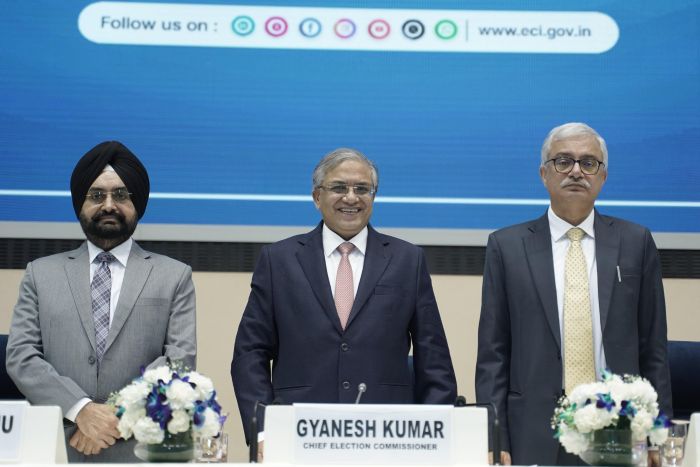
Picture Credit : @ECISVEEP/X
Chief Election Commissioner Gyanesh Kumar has said pure electoral rolls are the bedrock of democracy and the SIR of electoral rolls was conducted with the clear objective of ensuring that no eligible voter is excluded and no ineligible person is included.
According to PTI, Addressing a press conference in Kochi after reviewing preparations for the upcoming Kerala assembly elections, he said democracy was not new to the state and that Kerala had taught democratic practices to many parts of the country and the world.
Recalling his association with the state, Kumar said Kerala had been his workplace for 18 years and he had served as the Ernakulam Collector around 22 years ago.
He said Kerala had ‘Nattukuttams’ (village gatherings) more than 1,000 years ago, which laid the foundation for collective decision-making.
“Kerala also made the first code of conduct way back in 1960, which was later adopted by the Election Commission of India in consultation with all political parties and which we today call the Model Code of Conduct,” he said.
The CEC said Kerala had also been a pioneer in election management, with the first pilot use of electronic voting machines introduced in 1982 in the Paravoor Assembly constituency.
“With this strong foundation, all political parties of Kerala and the entire election machinery of the state have declared in one voice that the upcoming polls will not just be for the state but a model for the entire world,” he said.
Kerala has 140 Assembly constituencies — 124 general seats, 14 reserved for Scheduled Castes and two reserved for Scheduled Tribes.
“Pure electoral rolls are the bedrock of democracy. The Special Intensive Revision (SIR) that was undertaken recently had a single and clear objective – that no eligible voter should be excluded and no ineligible person should be included,” he said.
He said Kerala has 2,69,53,644 voters, which is more than the combined population of Australia, Norway and Costa Rica.