
Venkatesh Parthasarathy Revisits the Power Struggles That Shaped Eighteenth-Century India
‘The wars that gave the British their playbook for conquering India, and the warning they hold for a new age of proxy conflict.’
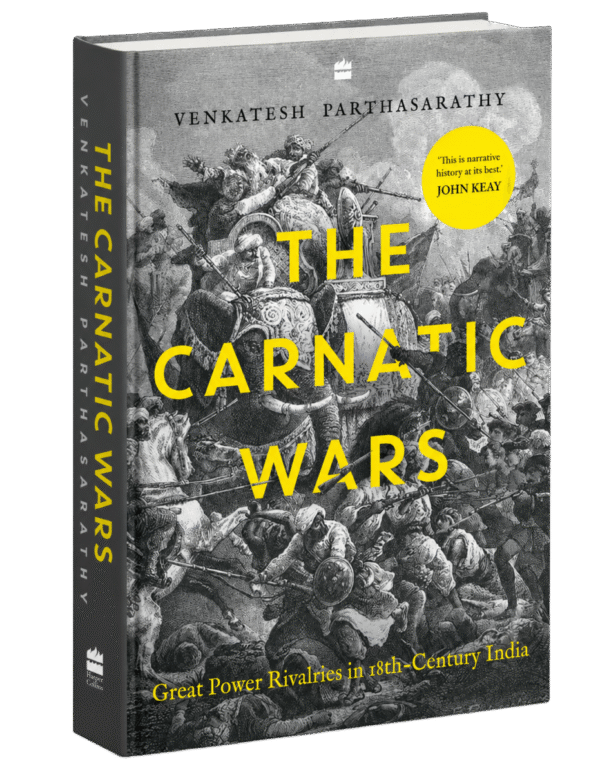
‘This is narrative history at its best.’ JOHN KEAY
‘Will keep all connoisseurs of historical detail and atmosphere riveted.’ T.C.A. RAGHAVAN
In the mid-eighteenth century, a contest between two factions of the Deccan aristocracy for the title of the Nawab of Arcot (in modern-day Tamil Nadu) sparked a multi-decade struggle for supremacy in India known as the Carnatic Wars, which enmeshed the motivations of the two factions with those of the French and English trading companies. The military lessons learned during the conflicts at Arcot, Cuddalore, Pondicherry and Trichy were then applied by the English in their campaigns across the Indian subcontinent: against Siraj-ud-daulah in Bengal, the French at Wandiwash, Hyder Ali in Mysore, the Marathas and finally the Sikhs. The setbacks suffered and the victories gained in these battles may well have laid the foundations of the British Empire and altered the political course of the nation.
This epochal set of battles for political dominance is frequently reduced to a conflict between Joseph Dupleix and Robert Clive. It is this misleading binary that Venkatesh Parthasarathy seeks to address. Drawing on rigorous research and first-hand accounts of diverse players on that crowded stage, he reintroduces a forgotten episode in Indian history that features a host of larger-than-life characters and the complex interplay between local politics and global power rivalries. Vividly narrated and deeply engaging, this is a must-read for history buffs.
‘Great powers fighting by proxy is an age-old template, one perfected by the colonial powers in India. In the 1740s, in the rich lands of the southern Deccan, in present-day Tamil Nadu, two rival factions vying for the title of Nawab of Arcot became proxies in the global rivalry between England and France. When the smoke finally cleared after a decade of bloody conflict, the English had discovered the playbook that would enable them to conquer India. As the world becomes increasingly enmeshed in yet another great-power rivalry, it is worth revisiting the story of the Carnatic Wars and reflecting on the insights it continues to offer,’ says the author.
ABOUT THE AUTHOR
Venkatesh Parthasarathy is a history enthusiast who lives in southern India. This is his second book. His first effort was called Venkatesa Suprabhatam: The Story of a Beloved Indian Prayer.
PRAISE for The Carnatic Wars
‘In tackling the labyrinthine rivalries that convulsed peninsular India in the mid-eighteenth century, Venkatesh Parthasarathy takes on a task that has defeated many. He does so in style, combining original and painstaking research with an eye for detail and mastery of an always demanding narrative. This is narrative history at its best. In traditional accounts, the plots and hostilities generated by the English and French trading companies along with their local allies are generally assigned to the “Carnatic Wars”. Parthasarathy dismisses this catch-all term as a “mispronunciation of a misnomer”, and anyway misleading. Global rivalry between the Europeans was as much to blame as the cut-throat machinations of the local powers. When the English trading company finally emerged as pre-eminent in south India, the path to dominion throughout the subcontinent lay open. The Carnatic Wars are revealed as a decisive prequel to the Seven-Years’ War which is itself often billed as “the first World War”.’— John Keay, historian and author of India: A History
‘Venkatesh Parthasarathy’s deep dive into the Carnatic Wars provides a detailed and granular perspective of the mid-eighteenth century, illuminating why these military engagements in peninsular India were so important. It was through these contests that the East India Company acquired the tactical and strategic tools critical to its later successes that led to the defeat and colonization of India as a whole. The Carnatic Wars will keep all connoisseurs of historical detail and atmosphere riveted.’ — T.C.A. Raghavan, author and former Indian diplomat.
Releasing on 25 August 2026 | Available wherever books are sold