
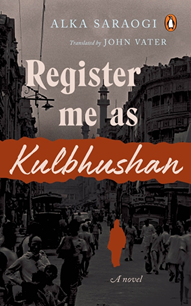
At Penguin Random House India, we are delighted to announce the upcoming release of Register Me as Kulbhushan by Sahitya Akademi Award–winning author Alka Saraogi, translated into English by John Vater.
Set in Kolkata, a city shaped by generations of migration and reinvention, the novel follows a man known by many names, Kulbhushan Jain, Gopal Chandra Das, Bhushan Chacha, as he attempts to formally reclaim his identity. What begins as a personal quest unfolds into a larger story of how displacement reshapes memory, belonging, and the self over time.
Through his journey, the novel captures the quieter aftermath of 1971, where survival often meant reinvention, and where entire lives slipped outside official records. At its core is the haunting idea of a “button of forgetting,” a way to survive trauma by erasing it, raising the question of what is lost in the process.
Through one man’s insistence on being recognised, on being put on record, Register Me as Kulbhushan becomes a powerful reflection on identity as something shaped by borders, bureaucracy, and the human need to belong.
At its centre is a man with many names, Kulbhushan Jain, Gopal Chandra Das, and Bhushan Chacha, moving through the streets of Calcutta in search of recognition. His life, shaped by displacement, unfolds as an ongoing attempt to reconcile who he has been with who he is allowed to be.
To survive his past, he turns to a phrase taught by his childhood friend Shyama Dhobi: a “button of forgetting,” a way to induce instant amnesia and move past unbearable memory. But survival through forgetting comes at a cost, slowly eroding the very history that defines him.
Running alongside is Shyama’s own journey, from a washerman to a trusted presence within elite Bengali households, before being drawn into the political upheavals leading up to the Bangladesh Liberation War. Together, their lives trace a cross-border history of migration, aspiration, violence, and survival across India and East Pakistan.
At once wry, philosophical, and deeply moving, Register Me as Kulbhushan is a layered exploration of identity, memory, and belonging across borders and time.
WHY THIS BOOK MATTERS
The Aftermath of 1971, Revisited
Moves beyond historical events to examine the long, undocumented lives built in their wake.
Identity as Instability
Explores how names, communities, and belonging shift over time under social and political pressure.
Memory vs Survival
Through the “button of forgetting,” the novel interrogates forgetting as both coping mechanism and loss.
Kolkata as a Migrant City
A living landscape of arrivals, negotiations, and layered histories.
Fiction as Record
Reconstructs lives that exist outside official archives, turning storytelling into documentation.
ADVANCE PRAISE
“[This] is a sharply observed and deeply nuanced portrayal of the fractures that run through Bengal’s various communities, and the recurring violence those divisions ignite. Alka Saraogi, one of India’s greatest writers, is served brilliantly by this inventive translation, which brings her vision to vivid life.”
— Amitav Ghosh, author of The Shadow Lines and The Hungry Tide
“A tale told with exceptional poignance and pathos, Register Me as Kulbhushan confronts us with the cheerless existence of the poor, the unwept and the unrecognized. Set against the bloody backdrop of the creation of Bangladesh, it lingers long as a lament on the futility of simple human goodness in the face of the brutality and heartlessness of the privileged and the powerful.”
— Geetanjali Shree, author of the International Booker Prize–winning Tomb of Sand
ABOUT THE AUTHOR
Alka Saraogi is a Hindi author based in Kolkata and a prominent voice of the Marwari diaspora. Her debut novel Kali-Katha: Via Bypass won the Sahitya Akademi Award in 2001, making her the youngest Hindi writer to receive the honour. She has written nine novels and two short-story collections, and her work has been translated into several Indian and international languages, including German, Italian, Spanish, and French. She is the recipient of multiple literary honours, including the K.K. Birla Foundation Award and the Indu Sharma International Katha Samman, and was awarded the title of ‘Cavaliere’ by the Government of Italy.
ABOUT THE TRANSLATOR
John Vater is an American writer and literary translator. He is the co-translator of The Play of Dolls by Kunwar Narain and co-author of More Than the Eye Can See: Memoirs of Gopinath Pillai. A Fulbright–Nehru scholar and graduate of the University of Iowa’s Literary Translation Workshop, his work has appeared in Ploughshares, Words Without Borders, Two Lines, and The Bombay Review, among others.