
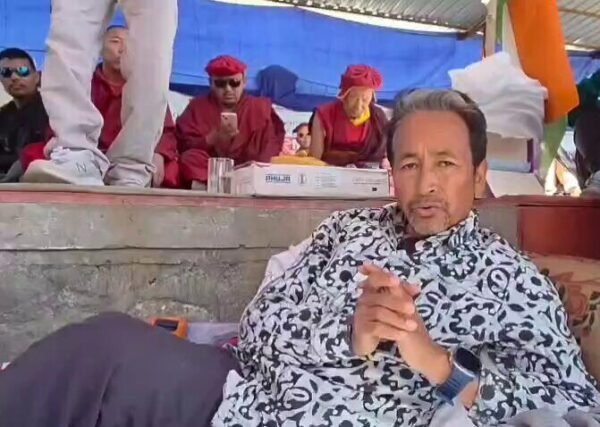
Picture : @Wangchuk66/X
Newsmaker: Sonam Wangchuk’s Reform Journey Enters a Crucial New Phase with Challenges Ahead
An engineer, a climate activist, and an education reformer from Ladakh, Sonam Wangchuk is widely recognised for founding SECMOL (Student’s Educational and cultural Movement of Ladakh) in 1988 and for developing the ‘Ice Stupa’ artificial glacier technique. Wangchuk,59, is globally renowned as a passionate advocate for the environment and his home region and has also been involved in public demonstrations for greater constitutional safeguards for Ladakh.
Son of a noted politician Sonam Wangyal, Wangchuk’s family was one of only five households in the alpine hamlet of Uleytokpo—about 44 miles (70 km) from the city of Leh in present-day Ladakh, then part of the state of Jammu and Kashmir. Since the remote village didn’t have a formal school, Wangchuk received basic education from his mother, Tsering Wangmo, whom he once described as “never schooled but highly educated.” Wangchuk began attending formal school only about age nine, when the family moved to Srinagar, after his father was elected to the state’s legislative assembly.
Wangchuk had a difficult education because teaching standards were abysmal, textbook content locally irrelevant, and the medium of instruction alien in the mountains. Having spoken only Ladakhi as a child, Wangchuk struggled at school in Srinagar, where the language of instruction was mainly Urdu. He graduated from National Institute of Technology in Srinagar, Kashmir. In 1988, after earning his engineering degree, Wangchuk founded Students’ Education and Cultural Movement of Ladakh (SECMOL) and started coaching Ladakhi student, 95 per cent of whom used to fail the government exams.
SECMOL started by giving supplementary lessons to academically weak students and partnered with local schools to institute reforms, emphasizing hands-on learning, remedial language lessons, and teaching methods and materials rooted in local culture. The approach drove down the failure rate in schools and in 1994 led to the launch of Operation New Hope, which expanded the educational reform program across Ladakh. Launched by SECMOL in collaboration with governmental and non-governmental bodies, Operation New Hope later became part of the regional government’s official education policy.
In 2013 Wangchuk came up with an idea to improve on a method to freeze glacial meltwater developed by fellow engineer Chewang Norphel. The idea was intended to address the shortage of water that cultivators face during the dry season in Ladakh, which is a high-altitude cold desert. With the help of his students, Wangchuk froze stream water into conical artificial glaciers—or ice stupas, to store water during the winter and release it throughout the drier spring and summer.
The ice stupa won him a 2016 Role Award for Enterprise. Further, for his contributions to reforming education in Ladakh, Wangchuk was awarded the Ramon Magsaysay Award in 2018.
An activist throughout his life, Wangchuk grabbed the attention in September 2025 for “climate fast” seeking Sixth Schedule status and drawing attention to how mining and commercial interests were putting Leh region’s fragile ecosystem and the tribal livelihoods linked to it at risk. Wangchuk was detained under the extremely strict National Security Act later. Police claimed his alleged links to Pakistan, citing a climate conference he had attended in the neighbouring country. He spent 170 days in custody until the government revoked the order.
IT’S A VICTORY OF DEMOCRACY
direct democracy… straight from the streets.
It’s a victory of peace, patience & persévérance.
Congratulations CJP, Gen Z of the nation and thank you all citizens for shedding fear and the fear of fear and rising up from every corner of the nation.… pic.twitter.com/rSLOfvba2R— Sonam Wangchuk (@Wangchuk66) July 25, 2026
Recently, Wangchuk extended his support to the Cockroach Janta Party (CJP), born out of an offhand comment by Chief Justice Surya Kant and snowballed into a campaign against apparent lapses in national exams. In June 2026 he joined the movement’s protest at Delhi’s Jantar Mantar and sat on a hunger strike demanding the resignation of education minister Dharmendra Pradhan and asking for a speedy resolution to the question of Ladakh’s autonomy. On the 21st day of his fast, the Delhi Police removed him from the grounds by force and took him to a hospital. Wangchuk continued with his fast. On the 26th day of his fast, he was convinced to break it by a delegation of union ministers who met him at the hospital. His decision came after a public assurance from Modi that his cabinet would take “strict action” on the issue of examination mismanagement through parliamentary process, and Wangchuk’s other demands were addressed. On July 25, Education Minister Dharmendra Pradhan resigned.
END OF HUNGER… BEGINNING OF ACCOUNTABILITY…!
Sonam Wangchuk ends his fast after 26 days upon getting assurance from the government and members of parliament of all political parties that the issue of accountability in the failing examination system will be discussed on the… pic.twitter.com/0C9YX5VlsL— Sonam Wangchuk (@Wangchuk66) July 24, 2026
Though, the protest has ended officially, Wangchuk continues with his reforms and initiatives for the betterment of the people of Ladakh.