
A Powerful Memoir of Afghanistan’s Journey Through Elections, Hope and Human Resilience
‘No one shared my excitement about my election assignment in Afghanistan. My husband said I should write a will. A close friend suggested that I had a death wish.’
This was the unanimous reaction when IAS officer and election expert Satbir Bedi was selected by the United Nations to oversee the 2005 elections in Afghanistan, the country’s first widely contested parliamentary elections since 1969, held in the aftermath of 9/11. While much of the world saw Afghanistan through the lens of war, terrorism and military intervention, Bedi stepped into a country attempting something far more fragile: rebuilding democracy, one vote at a time.
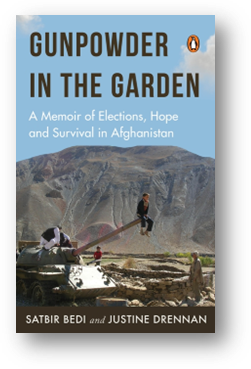
On 15 August 2026, the world marks five years since the Taliban returned to power in Afghanistan, bringing an abrupt end to two decades of democratic institution-building and reversing many of the freedoms that millions of Afghans, especially women, had fought to secure. At a moment when the country’s recent history is once again in sharp focus, Gunpowder in the Garden revisits a brief but extraordinary period when hope rested not on the battlefield, but at the ballot box. Through Bedi’s firsthand account, the book documents one of the most ambitious democratic exercises ever undertaken in a conflict zone, offering readers a perspective that feels especially relevant today.
More than a story about elections, Gunpowder in the Garden is about people. It follows Afghan women determined to cast their vote despite intimidation, villagers choosing between fear and hope, former refugees returning to rebuild their lives, and communities struggling to imagine a future beyond conflict. Running alongside these stories is Bedi’s own deeply personal journey, as she navigates the pressures of leading an election mission in one of the world’s most dangerous regions while her marriage quietly unravels back home. The result is an intimate and moving account of resilience, humanity and the quiet acts of courage that history often overlooks.
At a time when democracy, elections and institution-building are increasingly debated across the world, Gunpowder in the Garden offers a rare insider’s account of what it takes to build trust in places where conflict has eroded it. Drawing on her experiences working with Afghan officials, local communities, former mujahideen, international agencies and even negotiating channels that intersected with the Taliban, Bedi paints a nuanced portrait of a country far richer and more complex than the headlines ever allowed.
Bedi says, “People have deeply etched preconceptions about Afghanistan and Afghans, stereotypes of violent men and oppressed women. I hope this book gives readers a more nuanced view of the country at a critical time. Kapisa province, where I led an election team in 2005, was a battleground of competing ideologies. People were tired of foreign occupiers, and the Taliban were regrouping, yet many brave women and men still hoped for self-determination. I found many Afghans were more comfortable with me than with most other foreigners due to my being an Indian woman (and a Bollywood conduit). I also discovered that despite India’s electoral experience and Afghanistan’s long years of war, voters’ and candidates’ behaviour was remarkably similar. It showed me that democracy is fragile, and that elections alone could never ensure it.”
Satbir Bedi is one of India’s foremost election administrators and governance experts. A former IAS officer, she has overseen elections in some of India’s most sensitive regions, as well as Afghanistan. Her work has been at the forefront of strengthening democratic institutions across challenging political landscapes. In Gunpowder in the Garden, she brings together this unparalleled experience with deeply personal storytelling to chronicle one of the defining moments in Afghanistan’s modern history—and the remarkable people who lived through it.
The book is co-written with Justine Drennan, an award-winning journalist and editor whose reporting has focused extensively on conflict, politics and social change across South Asia and beyond. Her narrative expertise brings depth and immediacy to Bedi’s extraordinary experiences, transforming a remarkable chapter of diplomatic and electoral history into a compelling and deeply human story.