
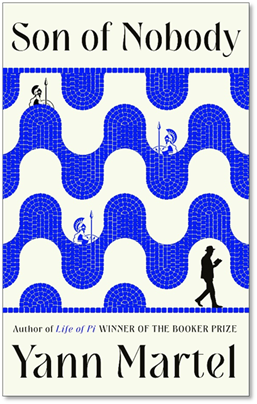
A daring reimagining of the Trojan War that bridges antiquity and modernity, tracing how stories survive across centuries to shape memory, identity, and loss.’
Featured across global round-ups including The Guardian, Financial Times, BBC Culture and Elle’s most anticipated books of 2026, Son of Nobody arrives as a work attuned to both literary tradition and contemporary unease.
At its centre is Harlow Donne, a scholar who travels to Oxford in pursuit of a rare academic opportunity, only to uncover something far stranger: fragments of a lost epic from the Trojan War. The poem, named The Psoad, shifts the lens of classical history away from kings and heroes, toward an unnamed foot soldier, “son of nobody,” whose voice has remained unheard for millennia.
Martel’s novel moves between ancient Greece and the present day, but its preoccupation is less with the past itself than with its afterlives. What does it mean to recover a story? Who has the authority to interpret it, and at what cost? As Harlow translates and annotates the text, dedicating it to his daughter, the boundaries between scholarship and invention begin to blur, raising questions about authorship, legacy, and the fragile line between truth and narrative.
In revisiting one of the foundational myths of Western literature, Martel resists spectacle in favour of intimacy. The Trojan War becomes not a site of heroism, but of anonymity; not a fixed history, but a text in flux. The result is a layered meditation on how stories are shaped, not only by those who live them, but by those who retell them.
Early responses have noted the novel’s formal ingenuity and emotional depth, with critics describing it as “ingenious” and “ambitiously innovative,” a work that both honours and unsettles the classical canon. As with Life of Pi, Martel once again invites readers into a narrative that is as much about belief as it is about storytelling itself.
For readers in India, where myth and modernity continue to intersect in public and private life alike, Son of Nobody resonates with familiar questions: how do inherited narratives shape identity, and how do we reconcile them with the urgencies of the present?
At a moment when literature is increasingly looking backward to make sense of a fragmented now, Son of Nobody stands as a reminder that the past is never fixed, it is something we return to, revise, and carry forward.