
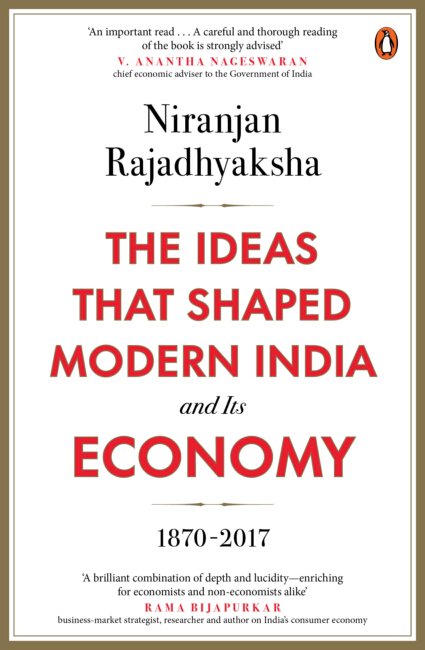
Penguin Random House India is proud to announce the forthcoming publication of The Ideas That Shaped India and Its Economy: 1870–2017 by economist and writer Niranjan Rajadhyaksha, to be published under the Vintage imprint in October 2026.
Why do some nations prosper while others struggle? What creates wealth? And how did generations of Indian thinkers imagine the economic future of a country moving from colonial rule to independence, nation-building, liberalisation and its emergence as a global economic power?
In The Ideas That Shaped India and Its Economy, Rajadhyaksha tells the story of modern India through the economic ideas that helped build it. Beginning with the early economic nationalists of the late nineteenth century and travelling through nearly 150 years of debate and policymaking, the book brings together economists, political leaders, reformers, businesspeople, trade unionists and dissenters who grappled with one fundamental question: How can India become prosperous?
The story begins with an evocative idea from nineteenth-century Marathi thinker Gopal Hari Deshmukh, better known as Lokhitwadi. Writing about economics in 1849, he turned to the ancient story of samudra manthan, the churning of the cosmic ocean, to make a modern argument: prosperity does not simply exist waiting to be distributed. It has to be created through human effort and ingenuity. This search for prosperity, or the “search for Lakshmi”, becomes a thread running through the book.
From Dadabhai Naoroji’s critique of colonial exploitation and the early calls for industrialisation, to debates around economic swaraj, Gandhian economics, national planning and the Nehruvian development model, the book shows that India’s economic trajectory was never the product of a single ideology. It emerged from a continuous contest of ideas.
Rajadhyaksha revisits some of the most consequential questions in modern Indian history: Should India protect domestic industry or embrace free trade? Should development be driven by agriculture or industry? Should scarce capital be invested in heavy industry or consumer goods? How much power should the state have over the economy? What should be left to markets? And how should India balance economic growth with stability and social welfare? These were not settled questions. They generated fierce disagreements whose influence continues to be felt in contemporary economic policy.
The book also recovers the extraordinary range of people who contributed to India’s economic imagination, moving beyond the familiar names to illuminate a much wider intellectual tradition. Its pages bring together competing and sometimes contradictory perspectives, demonstrating how economic thinking changed as India’s circumstances changed. As Rajadhyaksha argues, solutions appropriate to one period could become inadequate in another, making the evolution of economic policy as much an art of responding to changing circumstances as an application of universal principles.
The narrative ultimately moves towards the reforms of 1991 and beyond, when India decisively began dismantling an economic system built around extensive government controls, limited international engagement and the primacy of the public sector.
Yet the book places 1991 within a much longer intellectual history, showing how reform emerged from decades of argument about the limits of India’s earlier economic model.
At its heart, The Ideas That Shaped India and Its Economy makes a compelling case for taking ideas seriously. India’s economic history, Rajadhyaksha shows, is not a neat progression from one model to another but a “flowing conversation” shaped by debate rather than dogma. Questions around protectionism and free trade, the state and the market, domestic capacity and global integration, growth and stability have repeatedly returned in new forms.
That makes the book especially relevant today. As India confronts a new generation of challenges around manufacturing, infrastructure, energy, skills and structural transformation, many of the questions that occupied earlier generations have acquired fresh urgency. The book argues that India’s economic transformation has repeatedly involved identifying and overcoming its most pressing constraints, even as new ones emerge.
Accessible without sacrificing intellectual rigour, The Ideas That Shaped India and Its Economy is both an economic history and a history of ideas. It offers readers a new way of understanding how modern India came to be, and why the arguments of its past remain essential to thinking about its future.
About The Author
Niranjan Rajadhyaksha is an economist and writer. He is the executive director of Artha Global, a public policy consulting firm, and has previously been research director at IDFC Institute and executive editor of Mint. His fortnightly column, Cafe Economics, has won several national and international awards. His career across financial journalism, policy research and academia has been defined by a longstanding engagement with the Indian economy.
The Ideas That Shaped India and Its Economy: 1870–2017 will be published by Vintage, an imprint of Penguin Random House India, in October 2026.