
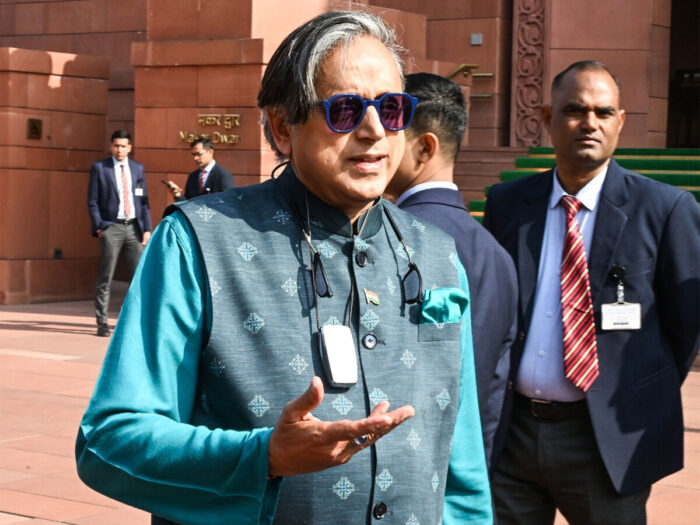
Picture ANI/X
The India-US interim trade deal looks more like a “pre-committed purchase agreement” that overturns every principle of reciprocity, Congress MP Shashi Tharoor said and slammed Union ministers S Jaishankar and Piyush Goyal for playing “ping pong” when questions are posed.
Initiating a debate in the Lok Sabha on the Union Budget, Tharoor said the government’s claim that India has secured a “better deal” than China, Vietnam, or other Asian economies does not withstand scrutiny.
“While India may have obtained tariff reductions of one or two percentage points, no East Asian economy has agreed to deliberately dilute its trade surplus with the United States through guaranteed purchase commitments,” he said. The Congress MP from Thiruvananthapuram asked how one could speak of a “reciprocal tariff” of 18 per cent on one side and zero per cent on the other. “It looks less like a free trade arrangement and more like a pre-committed purchase agreement that overturns every principle of reciprocity,” he said.
At a time when India’s total bilateral trade with the US stands at roughly USD 130 billion and a trade surplus of nearly USD 45 billion, the government has surprisingly promised to buy USD 500 billion worth of American goods over five years, he said.
Tharoor argued that this effectively converts a surplus into a long-term deficit by executive assurance rather than by market demand. “No major economy has ever neutralised its own trade leverage in this manner. While the US continues to impose import tariffs of up to 18 per cent on Indian exports, we have committed ourselves to lower tariffs to near-zero levels, open agriculture, dilute data localisation, soften intellectual-property safeguards, and even redirect strategic energy imports, especially away from Russia, to meet purchase targets.
“This is not strategic balancing; it is economic pre-emption,” the Congress MP said. He said Parliament has neither been told how farmers, MSMEs, and the domestic industry will be protected nor why India has “voluntarily surrendered” its negotiating power without securing proportional market access or policy space in return. “I know the government will say wait for the final agreement, it is coming in mid-March, but let them be aware that these concerns exist right now,” he said.
“The government’s claim that India has secured a ‘better deal’ than China, Vietnam, or other Asian economies does not withstand scrutiny. While India has obtained tariff reductions of one or two percentage points as compared to them, no East Asian economy has agreed to deliberately dilute its trade surplus with the United States through guaranteed purchase commitments,” he said.