
Picture Credit : @PM_nepal_/X
Rebuilding Nepal Through Solidarity, Resilience, and Collective Action
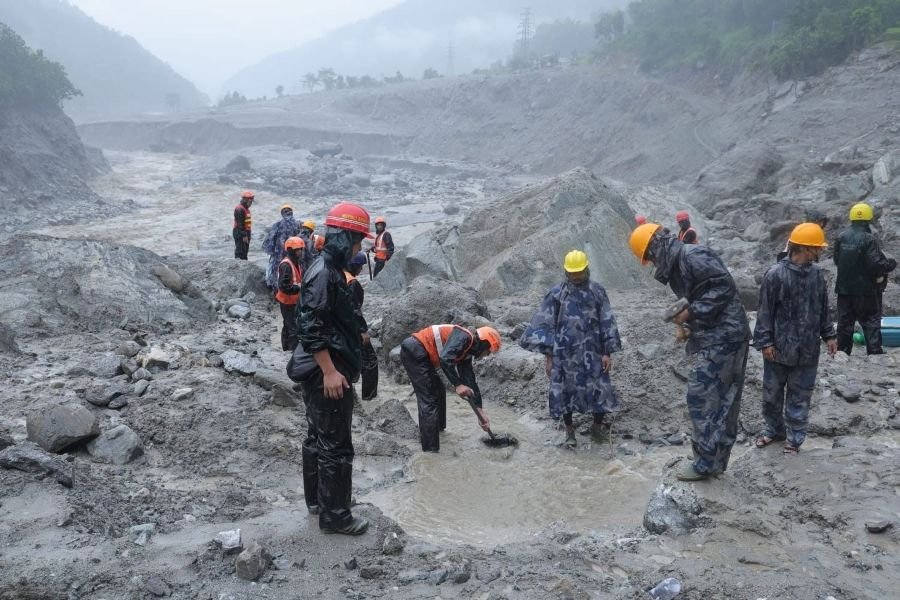
Post the flash floods, Nepal, once known for it’s scenic beauty, now poses a grim picture of future. When severe flash floods swept through northern Nepal, they changed thousands of lives in a matter of hours. Fast-moving floodwaters surged through peaceful communities in Rasuwa, Nuwakot, Dhading, Gorkha and Tanahun districts, washing away homes, roads and bridges and cutting off entire villages. Families are now left without reliable access to safe water, healthcare, schools and other essential services, while rescue teams continue to face challenges in reaching affected communities.
More than 65,000 people, have been affected. Entire communities have been cut off after roads and bridges were washed away, making it difficult for rescue teams and humanitarian agencies to reach affected areas and assess the full scale of the disaster. With tragedy of this magnitude, children are often the hardest hit. Losing homes and belongings, many children can be left without access to school, safe water, healthcare, and the support of their community. Over 19 schools have been destroyed along with 80 more schools along the river have been affected.
We deeply appreciate Prime Minister @anwaribrahim for your kind words of solidarity.
The Government of Nepal is utilising all resources at its disposal for the search, rescue and relief efforts for all those affected. https://t.co/44sh46k1tb
— PMO (@PM_nepal_) August 27, 2026
The Government of Nepal is leading and coordinating the response, determining what is needed on the ground, with strong direction coming from Prime Minister Balendra Shah. The Government and the UN are working through joint teams, or clusters, grouped by area of need, such as health, shelter or food, with the two sides meeting regularly to keep the response aligned.
UNICEF, too, is working closely with the Government of Nepal and partners to provide lifesaving support across health, nutrition, water, sanitation and hygiene (WASH), education, and child protection. Emergency hygiene kits are already being distributed and is also supporting the delivery of medical tents, bed nets, new-born kits and therapeutic food for children experiencing acute malnutrition in the hardest-hit communities.
The Nepal government has become more proactive in seeking logistical and technical assistance from foreign governments. The immediate need is increasingly about reaching places that conventional rescue operations cannot easily access and identifying victims whose remains have yet to be matched with families.
India and China, have deployed specialized tunnel-rescue teams to work alongside Nepali security personnel at hydropower projects in the disaster-hit areas. An 11-member Indian team is working at Mailung, the site of the Chilime Hydropower Project, while a nine-member Chinese team has been deployed at the Upper Trishuli 3A project site in Syabrubesi.
India’s assistance has also extended from rescue to the identification of the dead. An 18-member team of Indian forensic experts specialising in DNA analysis are already working with the Nepal Police Central Forensic Science Laboratory and Tribhuvan University Teaching Hospital. As the authorities struggle with the large number of unidentified bodies, Singapore is preparing to contribute another specialized capability. The Singapore Police Force is deploying officers trained in Disaster Victim Identification (DVI) at Nepal’s request.
India continues to extend humanitarian assistance to Nepal.
The fifth Indian aircraft landed in Nepal in the morning, carrying an 11-member rescue team with specialised equipment and 5.5 tonnes of essential medicines. Ambassador Naveen Srivastava handed over the fresh tranche of… pic.twitter.com/vwBg97Xkwb
— Randhir Jaiswal (@MEAIndia) September 2, 2026
India’s technical rescue team, in coordination with the Nepali Army, made progress at Chilime and Langtang sites. Rescue efforts to continue tomorrow. https://t.co/5N64X6J60h
— Randhir Jaiswal (@MEAIndia) August 31, 2026
The need for such support has become more urgent as the authorities confront not only the number of dead but also the logistical difficulties of recovering and preserving remains. Nepal has already received airtight body bags, with additional supplies being sent by India and China, while it has sought more freezers for storing bodies. Nepal has also requested Bailey bridges and high-capacity drones. Some Bailey bridges have already been received, while high-capacity drones are expected from China and Singapore. Japan and the Republic of Korea are also expected to provide specialised equipment soon. South Korea has already deployed a rescue team to the affected areas with drones and other equipment. Australia, meanwhile, has sent 12 response personnel to Kathmandu, including crisis-response and consular officers and members of the Australian Federal Police. The Australian government has raised its humanitarian support for the disaster to $8 million. As many as 42 Australians remain missing in the floods.
With help pouring in from all the corners of the world, the focus remains on finding those still missing, recovering and identifying the dead, and helping communities along the Bhotekoshi and Trishuli river corridors begin to recover.