
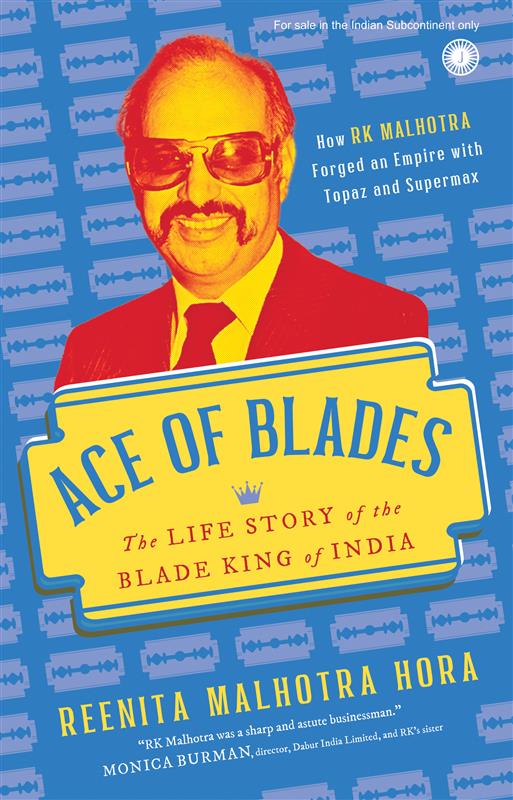
Ace of Blades: The Life Story of the Blade King of India is not just a business biography—it is a deeply personal, sharply etched portrait of obsession, ambition, and legacy. Spanning from the launch of Topaz in the 1970s to the dominance of Supermax through 2023, the book traces the extraordinary journey of RK Malhotra, the man who helped shape India’s shaving habits and built one of the country’s most recognizable FMCG empires. Written by his daughter, Reenita Malhotra Hora, the narrative carries both the authority of lived experience and the vulnerability of family truth.
From Topaz to Supermax: Building an Indian Icon
The early chapters ground the reader in post-independence India, where opportunity was scarce but ambition abundant. RK Malhotra’s entry into the razor blade business—beginning with Panama blades and later Topaz—reveals an entrepreneur driven less by comfort and more by an almost compulsive need to improve the product. This was not growth for growth’s sake; it was precision-driven expansion.
The arrival of Supermax in the 1980s marks a turning point. The book vividly captures how the brand challenged multinational dominance, particularly Gillette, which reportedly tried for years to acquire Malhotra’s business. These sections double as an accessible history of India’s FMCG evolution, showing how local brands learned to scale, compete, and win against global giants—often with fewer resources but sharper instincts.
Obsession as a Double-Edged Sword
One of the book’s greatest strengths is its unflinching honesty about the cost of greatness. RK Malhotra’s obsession with the “perfect edge” is portrayed as both his superpower and his flaw. Reenita does not shy away from depicting his volatility, exacting standards, and the emotional toll these took on colleagues and family alike.
This is where Ace of Blades transcends the standard business memoir. The factory floor successes are balanced with intimate personal turning points—strained relationships, family rifts, and the loneliness that often accompanies singular vision. The quoted line from RK Malhotra himself—“It is next to impossible to build up a good business… cherish it and look after it”—feels less like advice and more like a hard-earned confession.
A Family Saga Told from the Inside
Because the book is written by Malhotra’s daughter, it reads as much like a family saga as a corporate chronicle. The narrative is enriched by interviews with relatives, colleagues, and associates, lending it credibility while preserving emotional nuance. The Malhotra family’s internal conflicts—shaped by ambition, greed, loyalty, and love—mirror the pressures faced by many family-run enterprises in India.
Reenita’s voice is reflective rather than reverential. She writes with empathy, but not indulgence, allowing readers to see RK Malhotra as a fully human figure—brilliant, difficult, driven, and deeply flawed.
More Than a Business Biography
At its core, Ace of Blades is a coming-of-age story on multiple levels: RK Malhotra’s personal evolution, the rise of India’s FMCG sector, and the cultural shift of millions of Indian men for whom a Supermax blade became part of a daily ritual. The book’s cultural insights—about masculinity, work ethic, and post-liberalization India—add texture and relevance beyond boardrooms and balance sheets.

Final Verdict: Sharp, Honest, and Compelling
Ace of Blades is a razor-sharp saga of leadership and legacy that refuses to dull its edges. It will appeal equally to readers of biographies, business histories, and real-life family dramas. More importantly, it leaves the reader reflecting on a universal question: how much of oneself should be sacrificed at the altar of success?
This is not just the story of a blade king—it is the story of the price paid to stay sharp.