

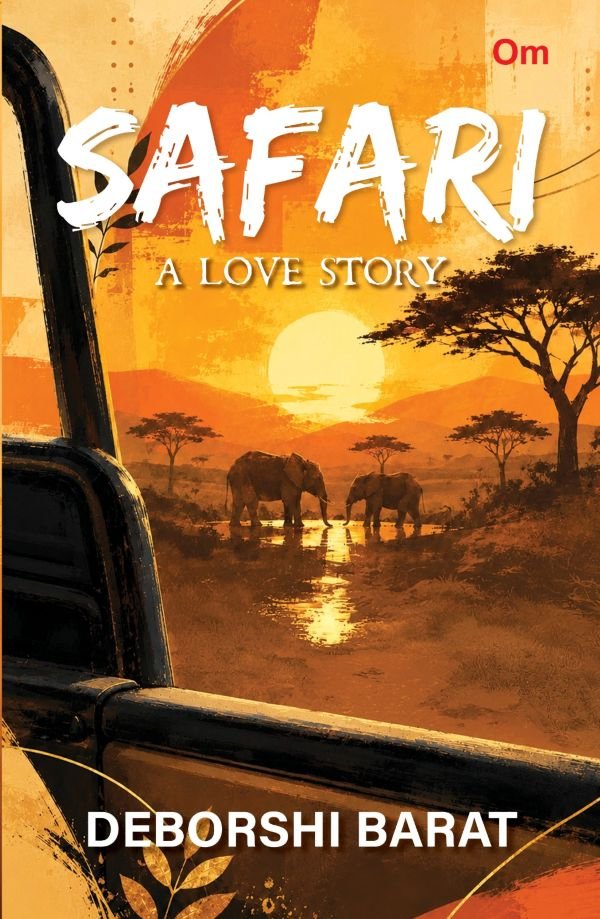
What if losing everything was the beginning of finding yourself ? In Safari – A Love Story , Deborshi Barat takes readers across the untamed landscapes of East Africa, where heartbreak gives way to unexpected romance, fractured friendships and life-altering choices. Blending sensual storytelling with themes of love, betrayal, identity and freedom, the novel explores the courage it takes to break free from societal expectations and embrace the unknown.
Through Niharika’s journey, Barat reflects on how moments of personal upheaval can challenge our deepest assumptions and reveal who we truly are. Set against the breath-taking wilderness of Africa, the novel reminds us that sometimes, the most transformative journey isn’t across the wilderness—it’s within.
Deborshi Barat is an Indian lawyer, public-policy advisor, academic and writer whose work spans law, governance and literature. He heads public policy and knowledge management at a New Delhi law firm, where he focuses on regulatory issues including data protection, artificial intelligence, clean energy and environmental, social and governance (ESG) matters.
A former Associate Professor at Jindal Global Law School, Barat holds a PhD from The Fletcher School at Tufts University. His doctoral thesis received the Peter Ackerman Doctoral Dissertation Award, while his writing on clean energy has earned thought-leadership awards from Legal 500 and Mondaq. Barat published his debut novel, The Hunter of Pigeons, in 2014. In addition to his work in law, academia and literature, he has also worked as an actor in theatre, Bengali cinema and television.
Here in a candid interview the author talks about his latest book and much more.
Excerpts :
Q : How different is Safari – A Love story from your previous book the debut novel The Hunter Of Pigeons in 2014
A: I think a lot of people have a story they desperately want to tell. For those who have the opportunity to translate this story into a book, it often becomes their debut novel. So it was with me and The Hunter of Pigeons. Although intended as a dark psychological thriller, it was also, in many ways, a coming-of-age narrative, written at a difficult and uncertain stage of my life: a kind of mental bridge between the past and the future, a reconciliation of the flights of fancy some of us are prone to during childhood with the grim realities of adulting. I tried to stretch the boundaries of imagination in Hunter as much as possible, without explicitly tipping into the zone of fantasy or horror.
In contrast, Safari is a more deliberate telling of a modern love story, stemming from a specific desire to write a relatable, cosmopolitan travel romance. The mood and setting in the two books are very different. While the camaraderie between two young boys, both teenagers with a deep sense of adventure, served as the main pivot in Hunter, Safari rests on the more mature friendship between two young women, both in their mid to late twenties, both working high-pressure jobs – albeit with different motivations. With the benefit of age and experience, Safari seeks to balance the effervescence of love, lust and youth with the inevitable trappings of modern life and professional hustle.
Q : So Safari – A Love story comes after a gap of 12 years. Any reason for the break
A: I guess life happened! I was moving around a fair bit in the intervening period, across geographies, disciplines and work. I wrote when I had the time, and a few drafts of other stories are tucked away for later. But Safari was something I kept coming back to intermittently, and various developments on the personal front kept me from devoting continuous attention to any one manuscript. Besides, as you know, it takes significant time and bandwidth to write and send out a full-length book and get feedback from different people before proceeding to the next stage.
Q : Any particular reason for opting for East Africa as background of your story
A : I’d travelled to Kenya many years ago, and it was a very special experience. Luckily, despite the temptation to soak in everything in real-time, I’d kept detailed notes during the trip, which came in handy while writing Safari, especially after I’d decided to set the story in Africa. Around the time I was preparing to move to the US for higher studies, I spent many months planning with a close friend to work together at the International Criminal Tribunal for Rwanda (ICTR). That’s how the tribunal in Tanzania came into play in Safari, through one of its principal characters.
Q : What is the message you want to convey to the readers through this book?
A: I wanted to focus on fundamentals – love happens, love dies, people change, commitments unravel, etc., but certain things remain relatively constant: things like friendship, family, deeply-held beliefs, ways of life, the magic of discrete moments, cultural memory, and so on. I particularly wanted to explore the theme of female friendship.
I’ve had the pleasure of knowing a lot of brilliant women in my life – and the privilege of having some of them as close friends – but I wanted to write about the experience of being a woman, and especially through the prism of friendship with another. Of course, there are certain difficulties in attempting this kind of writing when you are a man. You can train yourself to pay attention – observe small details, the way a woman talks, thinks, hesitates or leaves things unsaid. You can spend years noticing the women in your life and imagine – maybe, just maybe – you’re beginning to understand their inner monologue a little bit better than before. But as a man, you’re always aware of the severe limits to that understanding.
While writing Safari, I was constantly asking myself – how much of Niharika and Vania (the two principal characters) am I actually seeing, and how much am I unconsciously projecting onto them? In essence, I wanted to inhabit a psychological space that I could never achieve through my own lived experience. I tried to imagine their contradictions, ambitions, desires. I tried to understand the social expectations they navigate and the calculations which accompany them. But I could not pretend that it was the same thing. That distinction obviously matters.
In the end, I chose to embrace the premise that I shouldn’t even try to ‘write like a woman’, whatever that might mean to different people. There can’t possibly be any single way to do that, because women are not a uniform psychological category any more than men are. So I wrote Niharika and Vania as simply two individuals who are connected and fully themselves, warts and all, rather than as filtered through a man’s thinking. I wanted to allow them the same contradictions and freedoms we allow male characters: to be both selfish and generous, right and wrong, good and bad.
That way, Safari is an homage to human imperfections and the humility to appreciate the fragile beauty of our humanity. The process of writing Safari has taught me a lot about the possibilities and limits of ‘seeing’ another person. Perhaps that is what fiction asks of us in the first place – to enter the interior life and struggles of someone we can never completely know or comprehend. The book began with a woman I wanted to understand, and somewhere along the way, she became someone I wanted to simply listen to.
Q : Where did this interest in writing come from? Are they any inspirational writers whom you admire?
A: Like many people around me, I was a big reader growing up, and the interest in writing comes from admiring the work of some great writers – from the breathtaking beauty of Gabriel Garcia Marquez’s prose to the unsentimental detailing of Raymond Chandler.
Q : You are a Lawyer , a writer and also an actor . That’s amazing . How do you manage to divide your interests . How challenging it is.
A: I’ve been fortunate to have been afforded a few compartmentalized phases in life. While each such phase had its unique challenges – be it personal obligations, family reasons, health or otherwise – they also gave me a chance to immerse myself into one focused area of interest at any given time.
Q : Tell us about your acting stint . Your first break and what was the reaction in your family like.
A: In the last few years of school and through college, I was heavily involved in theatre, mainly English language plays. Later, I started auditioning for movies, and acted in a few Bengali films and mega-serials. Some of those movies went on to win national awards or got featured in international film festivals, and that was obviously a great feeling, to have been a small part of it. My family was aware of my interest in acting and were always supportive. Over time, as I entered deeper into law, academia and policy, it stopped being feasible to continue with acting in any meaningful way, whether after work or over weekends, since both theatre and film involve a significant amount of coordination with others and their schedules, and require a lot of time.
Q : What next after Safari – A Love Story. Are there any ideas floating in your mind to write on .
A: I am interested in speculative fiction, and my next book might just emerge from that interest. We live in an increasingly surreal world, where technological and geopolitical disruptions completely change things around every few months – and I often find myself needing to escape the weight of the present moment by imagining an alternative. As part of my work, I advise and write about AI and other emerging technologies, clean energy, data – and some of that professional exposure spills over into imagining what a collective future of our civilization might look like, including the many possibilities and potential variations.