
Should you tell HR your expected salary first? Should you ever work for free because a client promises “more business later”? Can you deliberately make an egotistical client want what you are selling? And could serving someone dessert—or changing where they sit—actually influence a multimillion-rupee negotiation?
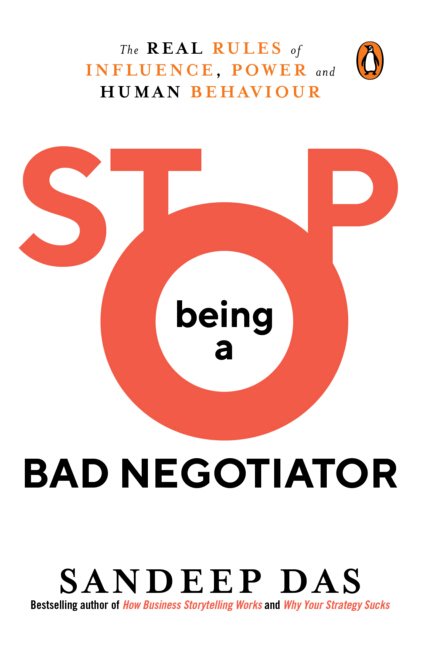
In Stop Being a Bad Negotiator: The Real Rules of Influence, Power and Human Behaviour, bestselling author and leadership coach Sandeep Das takes aim at one of corporate life’s most persistent assumptions: that good negotiation is fundamentally rational and should always seek a comfortable “win-win”. Das instead argues that the real battlefield is often psychological—leverage, fear, ego, perception, emotion and the ability to walk away can matter as much as the numbers on the table.
And Das gets remarkably specific. Don’t quote ₹35 lakh when ₹35.1 lakh might invite less haggling. Never appear desperate, because desperation destroys leverage. Ask open-ended questions—the book cites research analysing more than 60,000 instances of negotiation interactions that found negotiators asking more of them made more money. Beware the friendly executive who says their boss is the “bad guy”. And when someone insists that your competitor can do the job for half the price, sometimes the strongest response is to be prepared to walk away. Das draws on behavioural research as well as situations from more than a hundred leadership workshops to reveal how anchoring, loss aversion, reciprocity, storytelling, anxiety and subconscious biases play out when real money, careers and reputations are on the line.
Then things get even more unexpected. “Masala Dosa Always Sells!” examines whether food, venue and seating arrangements can change the dynamics of a negotiation; “Look at My Legs” explores why someone’s feet may reveal disengagement their face does not; “Does Screaming Actually Work?” dissects intimidation and the classic good-cop/bad-cop manoeuvre; while “Does Yes Mean Yes or Yes Mean No?” explores what happens when the same words carry radically different meanings across cultures. Along the way are the Mahabharata, M.S. Dhoni, Suits, The Dark Knight, CXOs bidding in a simulated IPL auction, salary negotiations, difficult landlords and venture capitalists. Behind the humour is Das’s larger argument for the AI era: as machines become better at traditionally cognitive tasks, the ability to understand, influence and negotiate with another human being becomes more—not less—valuable.
About The Author
Sandeep Das is a leadership coach, bestselling author and global speaker, and an alumnus of IIM Bangalore. A former director at PricewaterhouseCoopers and global foresight lead at Mars Wrigley, he has worked with more than 100 leadership teams worldwide, including executives at Unilever, Amazon, Infosys, Mondelez, Novo Nordisk and Pernod Ricard. He is the author of six books; How Business Storytelling Works remained on bestseller lists for forty consecutive weeks and is prescribed reading at IIM Bangalore and IIM Lucknow. He also teaches executive education and has written more than 200 opinion pieces for publications including The Times of India, Forbes, Fortune, Mint and The Economic Times.