
India’s space programme is one of independent India’s defining technological achievements. Yet, behind the satellites, launch vehicles and landmark missions lies the story of a leader whose contribution remains relatively less known.
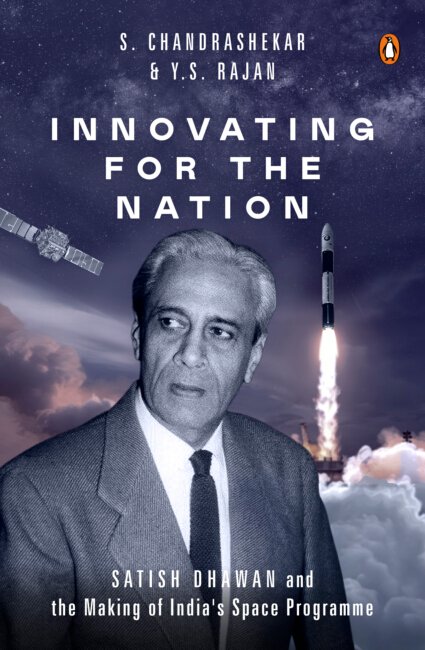
Following the death of Vikram Sarabhai in 1971, Satish Dhawan took charge of India’s space programme at a pivotal moment in its evolution. The task ahead extended beyond developing individual technologies. It required building scientific expertise, creating effective organisational structures and establishing the capabilities needed to sustain a national programme over the long term. Under his leadership, ISRO pursued a strategy centred on developing indigenous technological capabilities, an approach that would prove fundamental to India’s technological self-reliance.
The book traces this evolution through key projects and programmes, including the SITE experiment, the Aryabhata and Bhaskara satellites, APPLE, and the development of the INSAT and IRS programmes. It also examines the transition towards operational capabilities through initiatives such as ASLV, PSLV, INSAT and IRS, showing how individual projects contributed to the wider institutional and technological ambitions of the programme. Chandrashekar and Y. S. Rajan revisit the formative years of the Indian Space Research Organisation (ISRO), examining how Satish Dhawan helped transform a fledgling space effort into a technologically capable and globally recognised programme. Both authors worked closely with Dhawan during his tenure as Chairman of ISRO, bringing first-hand insight to an account that connects the organisation’s technological achievements with the leadership and institutional thinking that made them possible.
About the Authors
- Chandrashekar is an Honorary Visiting Professor at the National Institute of Advanced Studies (NIAS), Bengaluru. He retired as a Professor in the Corporate Strategy Area at IIM Bangalore in 2013. Prior to this he had spent more than 20 years working at ISRO. His work there covered all parts of the programme that included satellites, rockets and space applications. At ISRO, he also dealt with activities related to international co-operation that included all major powers as well as the United Nations Space Committee. His monograph, Space, War and Security: A Strategy for India (NIAS 2015) that outlines a space strategy for India has been translated into Chinese. His book China’s Space Programme From the Era of Mao Zedong to Xi Jinping was published by Springer in 2022. He has also extensively researched China’s Anti-Access Area Denial Strategy that deals with the Indo-Pacific region.
Y.S. Rajan has made key contributions to space research, technology and applications since 1964 and continues to be an important expert on space matters. As Scientific Secretary, ISRO, his contributions in shaping the organization from its initial experimental phases into a major service delivery organization was significant. After a thirty-year stint with the Government of India (GOI), he joined Confederation of India Industry (CII) in 1996. At CII, he strengthened and expanded their capabilities to interface with the government and academia on science and technology and business issues. As Vice-Chancellor, Punjab Technical University (PTU), he introduced key initiatives to improve the internal processes and the external interfaces of the university. He was Founder Chairman of Board of Governors of National Institute of Technology, Manipur (NITM). He was awarded the Padma Shri in 2012.
The official release for the book is in November 2026