
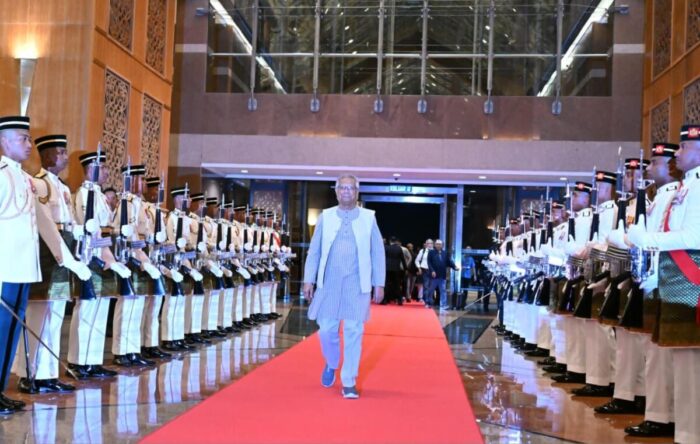
Picture Credit : @ChiefAdviserGoB/X
Bangladesh is facing tumultuous time ever. The failure of the interim government led by Muhammad Yunus to contain law and order in the country has led to innumerable attacks on the minorities , especially the Hindus. It’s political and religious landscape has witnessed a sharp sectarian turn since the ouster of former Prime Minister Sheikh Hasina in August 2024. What began as protests over job quota reforms soon escalated into a broader civil uprising. Exploiting the ensuing power vacuum, factions that include Islamist groups have expanded their influence, propagating anti-Hindu sentiment nationwide.
Bangladesh’s increasingly volatile political and religious climate has strained its already fragile relationship with India. Yunus now faces a confluence of crises ranging from Islamist extremism and sectarian violence to mounting geopolitical tensions. The growing vulnerability of religious minorities in Bangladesh, particularly Hindus, reflects both the resurgence of radical Islamist forces and escalating tensions with India.
The Bangladeshi Hindu community comprises about 8 percent of the country’s population and has historically aligned with Sheikh Hasina’s Awami League. Anti-India and anti-Hindu rhetoric has surged, fuelled by elements within the caretaker Yunus government and Islamist factions in the opposition Bangladesh Nationalist Party. Also, pro-Pakistan groups like Jamaat-e-Islami and Hefazat-e-Islam have capitalized on the political vacuum to push anti-India and anti-Hindu narratives. Amid such tense backdrop, the Yunus government has adopted a cautious approach toward protecting Hindu minorities and India. However, it remains to be seen if the new government is able to properly rein in Islamist extremism and safeguard minority communities.
Political analysts have raised questions over the safety of minorities and civil society activists in Bangladesh, with religious fundamentalists becoming more assertive and intolerant after Hasina’s exit. Radical Islamists have desecrated hundreds of Sufi shrines, attacked Hindus, prevented women from playing football in some areas and have also curtailed music and cultural shows. Human rights groups have also expressed increasing concerns over rising mob violence in Bangladesh in the past year.
Civil society activists in Bangladesh have criticised the interim administration for failing to stop the recent violence. Even before the protests, the interim government was under scrutiny as it struggled to maintain law and order and deliver results amid the political turmoil.
Dear friends, sisters, and brothers across Bangladesh,
Last Thursday is a day I will carry in my heart forever, the day I returned to the soil of my homeland after 17 long years. The warmth of your welcome, the sea of faces along the roads of Dhaka, and the prayers of millions… pic.twitter.com/3N6JFY7xMj— Tarique Rahman (@trahmanbnp) December 27, 2025
With the interim administration in Dhaka facing criticism over its lack of control and legitimacy, there is broad consensus that an elected government would be better positioned to address Bangladesh’s domestic and foreign challenges.
The country is scheduled to hold elections on 12 February but until then, Yunus has the difficult task of avoiding further violence. With Hasina’s Awami League banned from taking part in the polls, it’s widely expected that the Bangladesh Nationalist Party (BNP) will emerge as the winner. But Islamist political parties like the Jamaat-e-Islami can pose a challenge to the BNP.
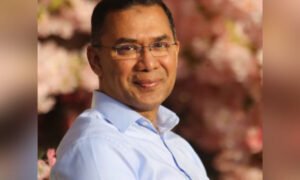
Bangladesh Nationalist Party (BNP) acting chairman Tarique Rahman returned home to a rousing welcome after over 17 years in self-exile In London , a move that is expected to energise his party workers ahead of the February 12 parliamentary elections. Rahman, has emerged as a leading contender for prime ministership in the polls even as the country’s Islamist party, Jamaat-e-Islami has been trying to expand its support base.
Policy makers in India are aware of the changing dynamics in Bangladesh. An Indian parliamentary panel said developments in Bangladesh pose “the greatest strategic challenge” to Delhi since the country’s independence war in 1971. India has already indicated that it will engage with an elected government in Bangladesh and that could pave the way for a diplomatic reboot.