
In 2005, life brought me back to England, where we were living in Surrey. The days unfolded gently, framed by the verdant calm of the countryside. My parents visited us during this time, and my mother, radiant in her resilience, had triumphed over breast cancer. Her only burden now was a slight arthritis in her knees, a reminder of life’s wear and tear. Arthroscopic surgery had left her with a modest limp, but she bore it with grace.
My mother and I shared a bond that transcended the ordinary. She was a very pious, unassuming, God-fearing person who bore the scars of life with a smile on her face.
Coming from a small hamlet in Punjab, almost illiterate and married in her teenage years into a misogynistic, patriarchal family of Ambala, she moved to Delhi with my father in the 1950s. Despite the turmoils, she bloomed, not withered.
My father taught her in his spare time and she passed her matriculation (tenth standard) exam after having three children. She became a voracious reader in the little spare time she had after caring for us and the regular intrusions of my father’s relatives coming to stay with us. She prided herself in bearing two boys in contrast to her four sisters who, between them, had only one boy and eight girls. I was her ‘bonus’ son, youngest, physically weak and fragile in my early years. She reared me closest to her heart. She would recite sacred Hindu texts and narrate mythological stories to me every day. In the stillness of the early mornings, we would sit together, her presence like a soothing balm. Our ‘heart-to-heart’ conversations were a sanctuary where life’s complexities unravelled.
Back in Surrey, she sensed the cracks forming in my marriage, her maternal intuition as sharp as ever. Despite her gentle probing, I could not bring myself to reveal the depths of my pain. Out of love or shame—perhaps both—I kept the reasons for our discord locked away. Her heartbreak was palpable, though she never voiced it. Instead, she turned inward, seeking solace in her prayers and meditations.
One day, I noticed an unsettling asymmetry in her face. My medical training kicked in instinctively, and as I conducted a neurological examination, my suspicions grew. Her left-sided facial muscles were weaker than the right—a subtle, yet alarming sign of what I feared might be a minor stroke. Without delay, I took her to the Accident & Emergency department.
The unfolding days brought a gradual slurring of her speech, though her spirit remained undiminished. As I sat beside her hospital bed, we continued our conversations—this time, not just about life, but about the nature of existence itself.
One morning, with an eerie calm, she confided, “My life has been fulfilled. It is time for me to go.” Her words hung in the air like a silent prayer. I brushed them aside, clinging to hope, convinced she had many more years ahead. She was only 72.
But the following day, the universe had other plans.
The brain scan report was devastating. The doctor’s words felt like jagged stones: a large, inoperable brain tumour, untamed and unforgiving. It wasn’t a recurrence of her breast cancer, as I had feared, but a new malignancy, a primary tumour born of its own volition. The prognosis was grim—three months at most.
I sought answers, travelling to the Royal Marsden Hospital, a bastion of neuro-oncology expertise. The verdict was the same, delivered with clinical precision: surgery was futile and would bring only temporary reprieve, at the cost of great suffering.
Yet, when I conveyed this to my family, disbelief and denial coloured their reactions. My father, with his characteristic resolve, insisted on taking her back to India for another opinion.
He refused to allow her to know the gravity of her condition, though I was certain she understood everything.
In India, hope flickered briefly, as local doctors posited the possibility of metastatic breast cancer, treatable with chemotherapy and radiotherapy. My mother, however, was steadfast. She did not want further interventions. Her voice, though gentle, carried the weight of finality: “I have lived my life fully.” My father, unwilling to accept this, convinced her to undergo surgery, his words an echo of a lifetime of decisions made on her behalf. I knew she had surrendered, not to the disease, but to his will.
The surgery only prolonged her suffering. She lost her speech, existing in a twilight of semi-consciousness. Fluid from her brain was drained repeatedly, each procedure a cruel invasion. Eventually, her body, exhausted by the battle, let go.
I was not by her side when she passed. Work had pulled me back to England, though I had said my goodbyes much earlier, and in my heart I knew she understood.
On 5th October 2005, in the stillness of dawn, I awoke in my luxurious Surrey home, ‘Serenity’. As I stepped towards the balcony, a black crow flew directly into the window, its impact resonating like a silent proclamation. In Hindu mythology, crows are believed to carry the souls of ancestors, and in that instant, I knew. My mother had departed this world. I carried on with my routine, the weight of knowing heavy on my chest.
At work, a phone call from my brother confirmed the inevitable.
Silent tears traced lines of sorrow and guilt down my face.
What use were my medical knowledge, my wealth, my manor-like home, or my Mercedes Benz when I could not save her? Guilt became my companion, shadowing me for days. Her death marked not just the loss of a mother, but the final fracture of my marriage. Sumita and I, already strained by the pressures of family and unspoken grievances, drifted beyond repair. Our son, Nitish, observed from the distance of his boarding school in Philadelphia, understanding in a way only a child of love and loss could.
I went back to India for her funeral. She was cremated in an electric crematorium. As per the Hindu rituals her ashes were to be immersed in the Ganges. My father refused to go to Haridwar. He hated the whole ritualistic business of pandits full of greed who try to make as much money as they can from the grief of people. But my mother was a believer and a devout Hindu. We had to fulfil her wishes as best as we could. So my brother and I, along with an uncle went with her ashes and did the needful. I could not feel any spiritual energy in the rituals performed in Haridwar. I wholeheartedly agreed with my father’s past observations. I started questioning my faith even more.
On our return to Delhi, I met Shyam Sunder, my close friend and hostel roommate from medical school. I shared my disquiet about it with him. He gave me an empathetic look and handed me The Tibetan Book of Living and Dying by Sagyal Rinpoche and said, “Just read it, you’ll find the answers you are looking for.” I read the whole book in two days. It had a deep impact on me. In the last 20 years, since my mother’s passing, I have explored Buddhist philosophy and the practice of mindfulness meditation in greater depth. I have attended residential courses and meditation retreats in Scotland’s Samye Ling Monastery, in Deer Park Institute near Dharamshala, India and in Amaravati Buddhist Monastery in Hemel Hampstead near London. I am still on that spiritual journey.
But in the aftermath of her passing, another question burned within me: How could my mother, with such conviction, defy medical predictions during her first battle with cancer? And how, when she decided her journey was complete, could she seemingly orchestrate her departure? It was as if her mind held the power to write the final chapter of her story.
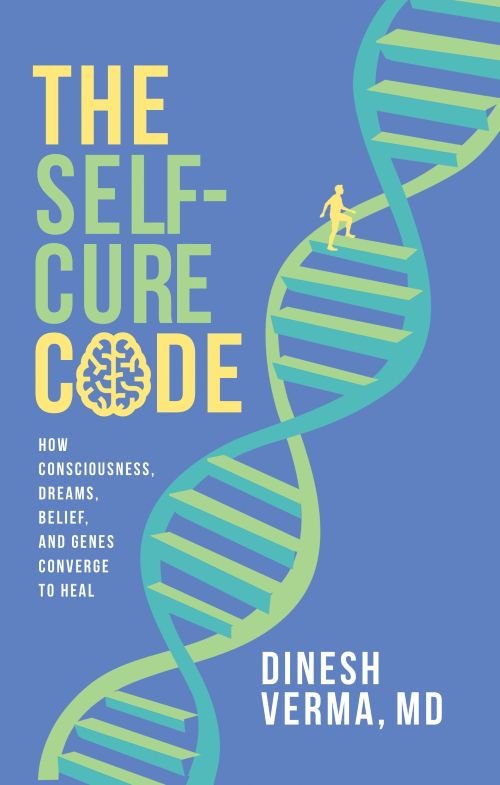
This question became her parting gift to me, igniting a fire that would burn for 20 years. It propelled me into a search—not just for answers, but for truth, for understanding the dance between the mind, the body, and the infinite. As I cared for my father through his battle with dementia in his final years, I delved deeper into this mystery. And now, dear reader, I invite you to my journey from a very humble childhood onto some of the top medical institutions rising to the heights of my profession, dipping to the depths of despair in relationships eventually passing through the same rabbit hole, to emerge with a transformed consciousness.
( Extracted with permission from author, publisher)