
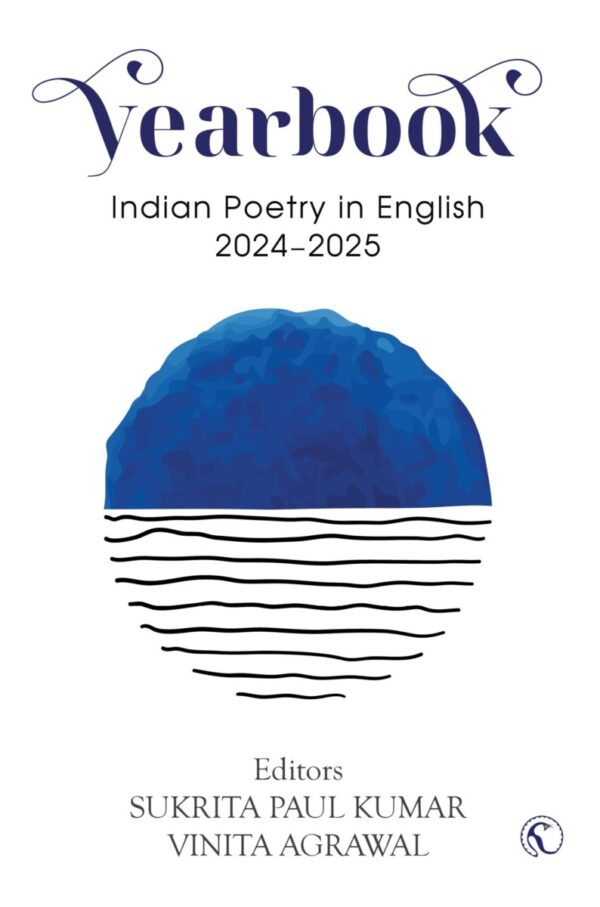
The Yearbook of Indian Poetry in English is a series of anthologies, published every year, of poems originally written in English by poets from Indian and the Indian diaspora. The series is founded jointly by Sukrita Paul Kumar and Vinita Agrawal.
THE REVIEW COMMITTEE FOR THE 2024-25 EDITION:
Kinshuk Gupta | Mamang Dai | Pramila Venkateswaran | Sivakami Velliangiri | Smitha Sehgal
The Committee is a beautiful blend of experienced and accomplished poets from India and abroad, alongside young and acclaimed names, who contribute to our vibrant literary heritage with this yearbook.
It is hoped that the exercise of bringing out such anthologies will prove to be fertile ground for establishing the aesthetics of Indian poetry in English. In the context of the instabilities and uncertainties experienced acutely in contemporary life, it is not surprising that many poems in the Yearbook emerge creatively from a special focus on home, house, identity, roots and indeed the question of language which is also deeply linked with the idea of homing.
This edition pays tribute to the Padma Shri awardee, poet and critic, Keshav Malik, on his birth centenary. The Yearbook also showcases the bilingual poet K. Satchidanandan as a Beacon Light of Indian Poetry in English.
Beginning with this volume, the Yearbook will feature an overview of Indian poetry in English published during the year, mapping poetry in English by Indians in India and abroad. Basudhara Roy an academic who is also a poet, highlights, in the first of these surveys, major thematic trends and forms visible in the poems published in 2024.
The Yearbook demonstrates the continued use of English as an indigenous Indian bhasha allowing the language of the region or community to be present in the poet’s consciousness. The mother tongue is not shunned as an interference but is negotiated with English, enriching thus the creative expression. The world has acknowledged authentic Indian English by awarding writers and poets with noteworthy awards. That same kind of authenticity of expression is evident in poetry in English today. The accelerated progress of such use of English can be traced ino the work archived in these Yearbooks, demonstrating the confident autonomy of the poet in choosing their own English. This volume of the Yearbook speaks powerfully against the atrocities in Gaza, in the voice of a poet from India’s North-East, among others. Periodicals The Bombay Literary Magazine, EKL Review and Muse India have nominated poems for consideration from the Yearbook in the past. This year, adding to this list is Wasafiri, a UK based publication.
While the poems submitted in each of the last five years for the Yearbook have been of a notable calibre, the year 2024-2025 has seen a significant leap in the number of remarkable poems received. This is what made the selection this year a very challenging task.
– Excerpted from the Foreword
ABOUT THE EDITORS:
SUKRITA PAUL KUMAR is a poet, scholar, critic and author who has won multiple prizes for her work, most recently the Rabindranath Tagore Literary Prize 2023. A former Fellow of the Indian Institute of Advanced Study, Shimla, and holder of the Aruna Asaf Ali Chair at Delhi University, she is series co-editor of the “Writer in Context” series published by Routledge, and the Guest Editor of Indian Literature, the journal of the Sahitya Akademi (Indian Academy of Letters).
VINITA AGRAWAL has authored five books of poetry, and won the Proverse Prize, the Rabindranath Tagore Literary Prize and the Gayatri GaMarsh Memorial Award for Literary Excellence, USA. She is on the Advisory Board of the Tagore Literary Prize, Co-chair for the Global Council for Excellence for Environment and Sustainability, and one of the twenty poets to be featured in a Taiwanese documentary on Asian poets, Deepest Uprising.
POETS INCLUDED IN THE YEARBOOK 2024-25
A.J. Thomas
Abhijit Sarmah
Aditi Bhattacharjee
Aekta Khubchandani
Afsar Mohammad
Aftab Yusuf Shaikh
Ajanta Paul
Alka Balain
Amit Shankar Saha
Amlanjyoti Goswami
Anant Mohan
Anindita Kar
Anita Nahal
Anju Kishore
Ankush Banerjee
Anu Majumdar
Aparna Chivukula
Arjun Rajendran
Arti Jain
Asijit Datta
Athira Unni
Atreyee Majumder
Barnali Ray Shukla
Basudhara Roy
Beena E.S.
Bhaswati Ghosh
Bilal Moin
Bina Sarkar Ellias
Boudhayan Mukherjee
Brindha Vinodh
Brishti Roy
Christina Daniels
Debasish Mishra
Debmalya Bandyopadhyay
Debolina Dey
Devashish Makhija
Dibyajyoti Sarma
Durga Prasad Panda
Gautam Vegda
Gayatri Lakhiani Chawla
Gobinda Biswas
Gopal Lahiri
Gopikrishnan Kottoor
Huzaifa Pandit
Indu Parvathi
Jahnavi Gogoi
Jaydeep Sarangi
Jennifer Robertson
Jinju S.
Jyotish Chalil Gopinathan
Kabir Deb
Kala Ramesh
Kamalakar Bhat
Kashiana Singh
Kavita Ezekiel Mendonca
Kavita Ratna
Kinjal Sethia
Kris Kaila
Kynpham Sing Nongkynrih
Lakshmi Kannan
Lopamudra Basu
M.J. Neela
Maaz Bin Bilal
Mandakini Bhattacherya
Mani Rao
Meena Kandasamy
Megha Sood
Mohua Chinappa
Neha Bansal
Pallavi Narayan
Pooja Garg
Pramila Venkateswaran
Prathibha Nandakumar
Preeti Vangani
Priya Narayanan
Priyanka Sacheti
R Suresh Babu
Rahana K. Ismail
Rajiv Mohabir
Ranjit Hoskote
Richa Sharma
Ronita Chattopadhyay
Rupa Anand
Sambhu R.
Sampurna Chattarji
Sandeep Kumar Mishra
Sandip Chauhan
Sangeeta Sharma
Sangita Kalarickal
Sanjeev Sethi
Saraswati Nagpal
Satya Dash
Sekhar Banerjee
Shalim M Hussain
Shanta Acharya
Sheena Laxmi
Shibani Phukan
Shikha Malaviya
Shikha Sawhney Lamba
Shikhandin
Shilpa Dikshit Thapliyal
Shoba Narayan
Shripad Sinnakaar
Sivakami Velliangiri
Sneha Roy
Snehal Vadher
Soni Somarajan
Suchi Govindarajan
Suchita Parikh-Mundul
Sudeep Sen
Sulekha Sarkar
Sunayna Pal
Sunil Sharma
Susmita Bhattacharya
Sutanuka Ghosh Roy
Tansy Troy
Teji Sethi
Tishani Doshi
Uma Gowrishankar
Unmana
Vidya Shankar
Vinay Sharma
Vivek Sharma
PRAISE FOR THE YEARBOOK OF INDIAN POETRY IN ENGLISH:
‘I applaud you (the Editors) for putting together the Yearbook… to celebrate all the ways that poetry has been written and celebrated in English over the last year’
– Christopher Merrill, Director of the Iowa Writing Program, Iowa, USA
‘Marvellous endeavour. I’ve been struck by the diversity of the poems and the locations of the poets. The Yearbook sits very well in the larger family of anthologies. It also makes up for a certain deficit that you have with periodic anthologies that might appear once in ten years. This is a good way of mapping and addressing the (poetry) scene as vibrant as it is, through a series of yearbooks benchmarking the scene of anglophone poetry in India’
– Ranjit Hoskote, Poet and Art Curator, Mumbai
‘A barometer of the poetry climate, the political climate of the nation. It is a very important record of what is being written and thought of by poets. Clearly the Yearbook (stems) from a deeply felt need. This was missing from the poetry scene. A valuable archive for students, readers and editors who would like to have some reference material of the poetry being written by Indians’
– Sampurna Chattarji, Writer, Editor and Translator
‘Editing a poetry yearbook in India is a Himalayan task considering its huge scope and cultural diversity.… a marathon venture made possible by the editors’ commendable spirit for inclusivity and commitment to poetry.’
– Jaydeep Sarangi, Poet; Anthologist; Principal, New Alipore College, Kolkata; and President of the Guild of Indian English Writers, Editors and Critics
| 216 pages | Paperback Rs 499 |
Published by Pippa Rann Books & Media | Distributed by Penguin Random House India