
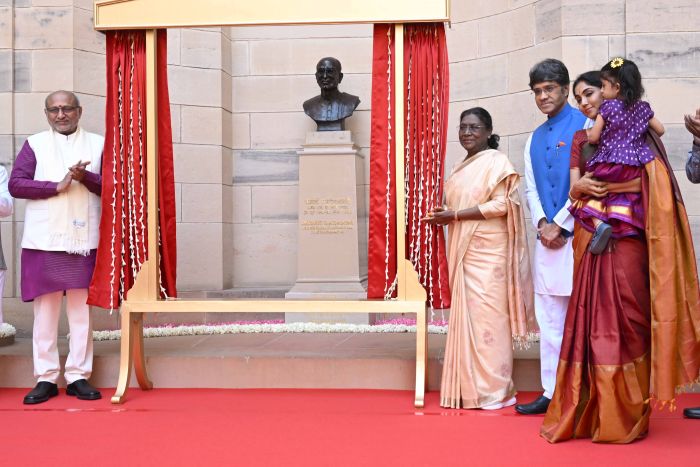
Picture Credit : @rashtrapatibhvn/X
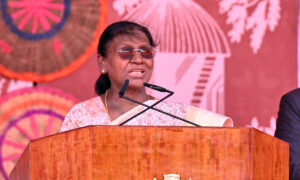
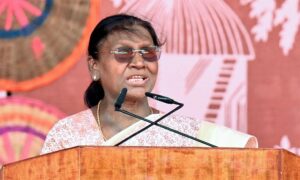
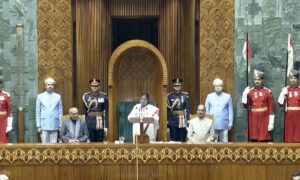
President Droupadi Murmu unveiled the bust of Rajagopalachari, also known as Rajaji, at the Grand Open Staircase near Ashok Mandap, opposite Mahatma Gandhi’s statue.
The initiative is part of a series of steps being taken towards shedding the vestiges of a colonial mindset and embracing, with pride, the richness of India’s culture, heritage and timeless traditions, a statement issued by the president’s office said.
Designed by Lutyens, the Rashtrapati Bhavan is the official residence of the president.
Originally built as the Viceroy’s House to serve as the residence of the British viceroy of India, the building was renamed Government House after independence on August 15, 1947. It was subsequently renamed Rashtrapati Bhavan during the presidency of Rajendra Prasad, marking its new role as the home of the president.
Several monuments, including the India Gate in New Delhi, were designed by Lutyens. Along with another distinguished British architect, Herbert Baker, Lutyens designed several government buildings in New Delhi.
President Droupadi Murmu unveiled bust of Shri Chakravarti Rajagopalachari Ji, the first and only Indian Governor General of independent India at Rashtrapati Bhavan.
The bust of Chakravarti Rajagopalachari, situated at the Grand Open Staircase near Ashok Mandap, replaces the bust… pic.twitter.com/xEkZHcwVhA— President of India (@rashtrapatibhvn) February 23, 2026
In a message sent for the occasion, Prime Minister Narendra Modi said the close relationship Rajaji shared with Gandhi, marked by deep mutual trust and friendship, is well known.
“Therefore, it is fitting that Rajaji’s bust is being installed right opposite the statue of Mahatma Gandhi. Further, the fact that Rajaji’s bust will be positioned where Edwin Lutyens’ bust used to stand is a crucial detail, making it an important act of mental decolonisation,” Modi said in the message, which was read out to the audience by Culture Minister Gajendra Singh Shekhawat.
The unveiling of Rajagopalachari’s bust at the historic central courtyard of the Rashtrapati Bhavan by the president is a moment of pride for the people of the country, Modi said.
“Today, Rashtrapati Bhavan stands not as a seat of power, but as a visible embodiment of democratic self-confidence rooted in Indian civilisation. Initiatives such as the ‘Rajaji Utsav’ and the unveiling of a bust of Shri C Rajagopalachari Ji reinforce this direction. They honour leaders who shared the nation and remind us that freedom is sustained by celebrating their memory,” he added.