
Picture Credit : @isro/X
ISRO Chairman V Narayanan has highlighted the importance of mission operations in ensuring success, calling it key to India’s expanding space programme.
He was addressing a gathering of scientists, industry experts, and students at the three-day international conference on Spacecraft Mission Operations (SMOPS-2026), themed ‘Innovative Operations for Smart and Sustainable Space Mission Managementâ Next Generation’.
“Mission operations are crucial, especially for long-duration ones. This is an important domain,” Narayanan said.
Welcoming delegates from leading global space agencies, including Roscosmos, the Japan Aerospace Exploration Agency (JAXA), the European Space Agency (ESA), and the French space agency, Centre National d’Etudes Spatiales (CNES), the ISRO chief said the conference marked a significant milestone, as it brought together international expertise, startups, and the broader space ecosystem on a common platform.
“This is not just another conference-it is quite a major global gathering with participation from many countries, experts, startups, and ecosystem partners,” he said.
Narayanan pointed to the successful Chandrayaan-3 mission, noting that the “historic landing” near the Moon’s south pole was the outcome of sustained teamwork and operational precision.
He credited the leadership and continuous involvement of senior scientists in mission control, saying their contribution remained indispensable during key phases.
The ISRO chief also recalled the challenges faced after the Chandrayaan-2 mission and said the subsequent success demonstrated India’s technological resilience.
“After the partial setback of Chandrayaan-2, Chandrayaan-3 had to be perfect,” he said, adding that the achievement had earned global recognition.
Tracing the evolution of India’s space programme since its inception in 1962, Narayanan said the country has accomplished a wide spectrum of missions spanning launch vehicles, scientific exploration, and satellite operations.
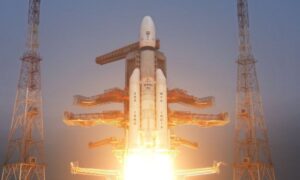
He added that while rockets operate for a brief duration, spacecraft require continuous monitoring and control over several years.
“While a rocket functions only for about 15 to 25 minutes, it must generate tremendous energy to place the spacecraft into orbit. However, the spacecraft itself must operate for years-sometimes from two to 15 years,” he said.