
Picture Credit : DD News /You Tube Video Grab
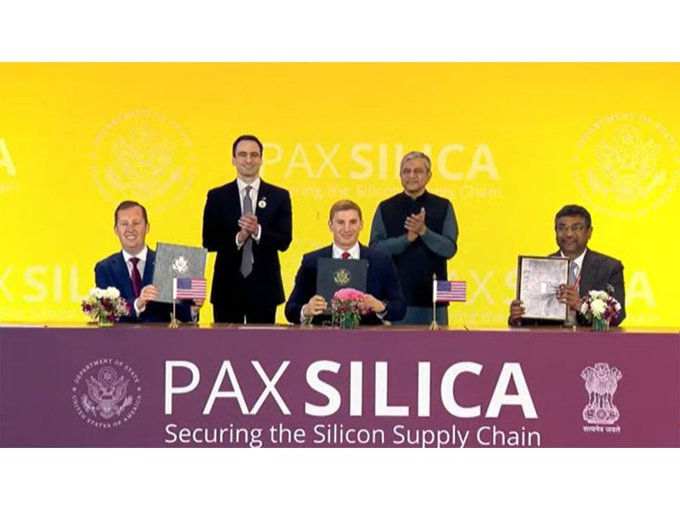
India has joined the US-led strategic alliance called ‘Pax Silica’ that aims to build a resilient supply chain for critical minerals and artificial intelligence with both sides projecting it as an initiative to cut over-dependence on one country, seen as an oblique apparent reference to China.
US Under Secretary for Economic Affairs Jacob Helberg, welcoming India to the coalition, flagged challenges arising out of “massively over-concentrated” supply chains for critical minerals and “threats of economic coercion and blackmail”.
Though Helberg didn’t name any country, it was almost clear that his remarks were directed at China’s export controls on rare earth minerals and related products.
China has been controlling the flow of rare earth minerals which have a wide range of applications including in electronics, clean energy, aerospace, automotive, and defence sectors.
US Ambassador Sergio Gor, welcoming India to Pax-Silica, said the country brings strength to the coalition.
“Policies that will reinforce US-India tech cooperation will power AI innovation and adoption for years to come. We can share trusted AI technology with the world and especially with partners like India,” he said.
“And critically, India brings strength. Peace doesn’t come from hoping adversaries will play fair. We all know they won’t. Peace comes through strength. India understands this. India understands strong borders,” he said.
“India understands this part of the world. That strength, that sovereignty is exactly what Pax-Silica amplifies. Because here’s the truth, strength multiplies when it’s connected.”
India signed a pact to formally join the Pax Silica at a ceremony held at the AI Impact summit. It was attended by Union Minister for Electronics and Information Technology Ashwini Vaishnaw, Helberg and Gor.
In his address, Vaishnaw framed the moment as one that transcends a ceremonial signing.
“We are not just holding a summit; we are building the future,” he said, emphasising that new foundations and new opportunities are being created for the younger generation.
He underscored India’s growing semiconductor capabilities, stating, “Today, India’s talented engineers are designing the world’s most advanced two-nanometer chips. The semiconductor industry will require around one million new skilled professionals, and this is a very big opportunity for India.”
New Delhi’s decision to join the coalition came amid efforts by both sides to finalise the proposed trade deal and move forward on several other initiatives to solidify bilateral ties after a period of severe strain.