
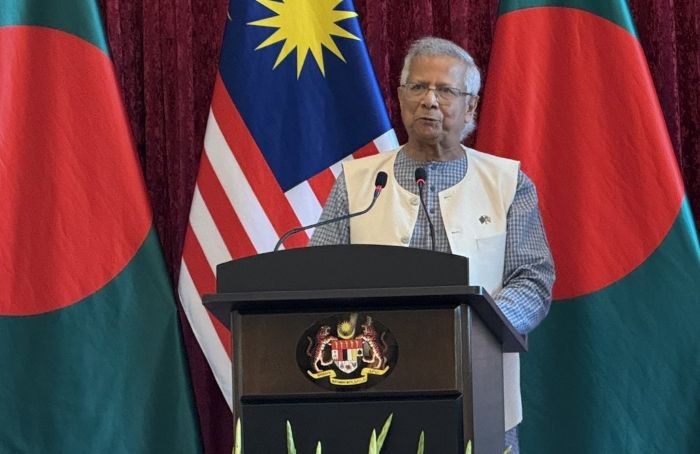
Picture Credit : @ChiefAdviserGoB/X
Outgoing interim government chief Muhammad Yunus has said his 18-month rule restored three core pillars of Bangladesh’s external engagement — “sovereignty, national interests, and dignity” — and it is no longer a “submissive” nation.
In his farewell address to the nation, Yunus said that at the end of his regime’s rule, “Today’s Bangladesh is confident, active, and responsible in protecting its independent interests”.
“Bangladesh is no longer a country with a submissive foreign policy or dependent on the instructions and advice of other countries,” he said in the televised address a day ahead of quitting power.
He emphasised that his 18-month tenure had rebuilt the three “fundamental foundations” of the country’s foreign engagement: “sovereignty, national interests, and dignity”.
Yunus’ interim regime began in August 2024 and is set to conclude its unscheduled term with the swearing-in of a new government led by the Bangladesh Nationalist Party on Tuesday, which won a two-thirds majority in general elections four days ago.
The BNP, led by its chairman Tarique Rahman, bagged a whopping 209 out of 297 seats in the crucial 13th Parliamentary elections held on February 12.
“I call upon everyone, regardless of party, creed, religion, caste and gender, to continue the struggle to build a just, humane, and democratic Bangladesh. With this appeal, I bid farewell with great optimism,” Yunus said.
Yunus, who ran the country as the outgoing regime’s chief adviser, effectively the prime minister, said Bangladesh’s open sea was its great “strategic asset”, creating huge economic opportunities in the region for the South Asian nation.
He emphasised the vast growth potential of broader regional cooperation encompassing Nepal, Bhutan, and “northeastern India”.
“Our open sea is not merely a geographical boundary; it is a gateway to the global economy,” he said, adding that connectivity was central to the country’s next phase of development.
Yunus said that his administration exhausted its efforts to “ensure democratic rights and values” and formulated some 130 new laws, amended other laws, and issued 600 executive orders, about 84 per cent of which have been implemented.