World Watch
#LookingBack2025WorldWatch: Assertive US President Donald Trump, Nobel Peace Prize For Maria Corina Machado ; Five-Time Prime Minister Sheikh Hasina Dramatically Ousted
The year 2025 has been a whirlwind of big events with personalities from several departments taking the centre stage


Picture Credit : @FoxNews/X
It has been a year of wars, ceasefires, controversies and of few personalities who made history. The year 2025 has been a whirlwind of big events with personalities from several departments taking the centre stage. While US President Donald Trump took office for his second term and imposed high tariffs on countries. The past twelve months have been a trying time for international cooperation, as the forces of conflict and contention grew stronger. Following is the list of biggest newsmakers and news which ruled the headlines for the entire 2025:
Donald Trump
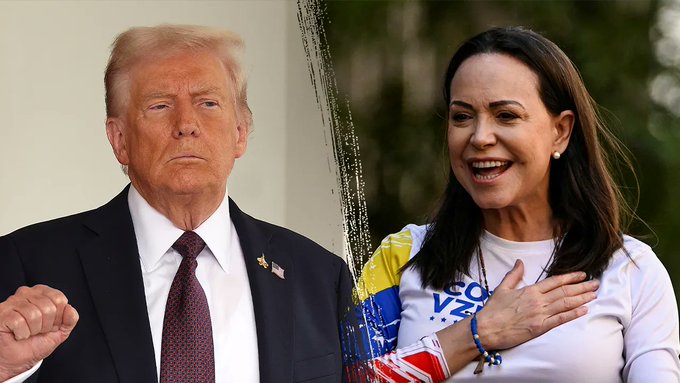
Undoubtedly, the second time US President Donald Trump was the headline for most part of the year, garnering continuous national and global attention since his return to the White House in January. Trump re-enacted mass deportations and imposed punitive tariffs on several countries, including India, over its Russian oil purchases. The fee hike for H1B visa was over the roof creating ripples in the corporate world , still reeling in uncertainity. He also ordered strikes on Venezuelan drug boats and claimed to have brokered a ceasefire for eight global conflicts, including the Russia-Ukraine war and the India-Pakistan conflict. His disruptions began even before he took office when he declared his desire to acquire Greenland, make Canada the fifty-first state, and reassert control over the Panama Canal. However his 100% tariff plan on China backfired when Trump was himself seen visiting China for negotiations. His meeting with Russian President Vladimir Putin in Alaska was yet another highlight of the year.
Elon Musk
Billionaire Elon Musk consistently dominated headlines this year, not only for his businesses but also for his political commentary, legal clashes, and controversial public statements. Musk came into the spotlight at the start of the year when he was appointed to the DOGE – a new department in Trump’s administration. However, he abruptly stepped down from the post in May, saying the role was “costing” him a lot and that he needed to refocus on his private ventures.
Maria Corina Machado
Maria Corina Machado, a Venezuelan opposition leader, became a major newsmaker this year after winning the Nobel Peace Prize for her “tireless work promoting democratic rights for the people of Venezuela and for her struggle to achieve a just and peaceful transition from dictatorship to democracy.” Her win spotlighted the ongoing crisis in the country and renewed international scrutiny on authoritarianism, human rights violations, and democratic backsliding.
Machado’s win also came at a time when US President Donald Trump was seeking to win the Nobel Peace Prize for allegedly brokering peace among nations. She had also dedicated her award to Trump for his “decisive support” for her country’s pro-democracy movement.

File Picture : @ANI/X
Sheikh Hasina’s Dramatic Ouster
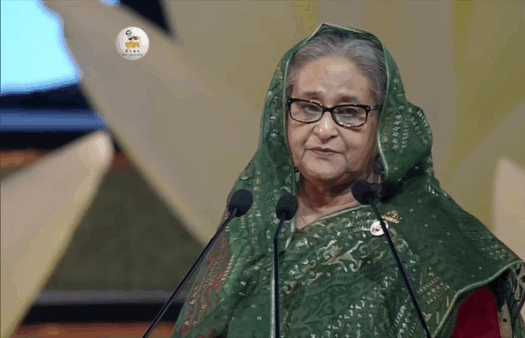
Sheikh Hasina, five- time Bangladesh Prime Minister (1996–2001, 2009–2024), was sentenced to death for ‘crimes against humanity’ committed during last year’s anti-government agitation that led to the fall of her Awami League government. Bangladesh’s International Crimes Tribunal found Hasina guilty on three counts – incitement, order to kill, and inaction to prevent the atrocities. She has also been declared a fugitive. The tribunal sentenced her with the death penalty for the same.
The 78-year-old former PM has been on a self-imposed exile in India since August 5, 2024 – as tens of thousands of violent protesters marched towards her residence in Dhaka and ousted her .

Picture Credit : @JPN_PMO
Sanae Takaichi
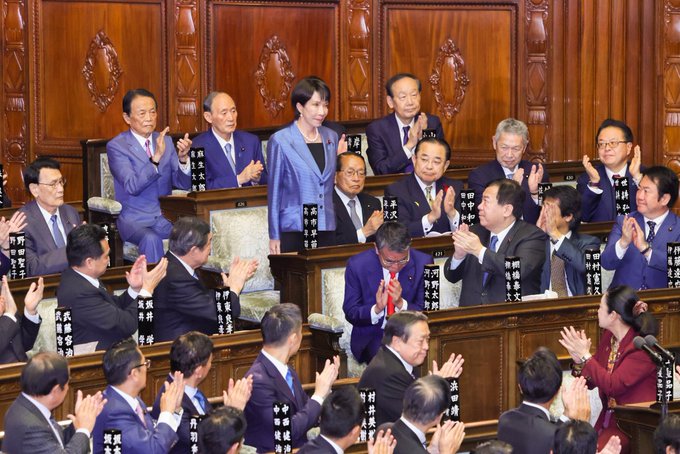
Sanae Takaichi made history by becoming Japan’s first female prime minister in October. However, her surprisingly male-dominated cabinet and socially conservative track record have left some women ambivalent in a country that lags on gender equality. When she is away from discussions and decisions on major issues such as diplomacy, the economy, and defence, Takaichi plays heavy metal drums. She uses her electronic drum kit at home to “let off steam” when the demands of public life become too much.
Pope Leo XIV
Pope Leo XIV, the first American Pope in history, was elected on May 8 this year. He was elected after the death of Pope Francis. The Roman Catholic Church has had 267 popes. Until 2025, not one of them had been from North America, let alone the United States. That changed in May. On April 21, the ailing Pope Francis died suddenly after suffering a stroke. The Roman Catholic Church then entered a period it calls the interregnum, which lasts until a new pope is selected. The 133 cardinals eligible to participate assembled in Rome, the formal process for selecting the next pope. The conclave selected Cardinal Robert Prevost after rigorous three ballots.
India Pakistan war:
The simmering tensions between India and Pakistan over the region erupted into open conflict in May, two weeks after five terrorists killed twenty-six people near Pahalgam. India vowed to do justice to the families who had lost their loved ones in the attack with a befitting reply to Pakistan. This time, it struck on “terrorist infrastructure” inside Pakistan, breaking the very backbone of terror organisations. Pakistan responded with drone and missile strikes against Indian military bases and shot down two of India’s most advanced fighter jets. India in turn destroyed air defence systems around the Pakistani city of Lahore. However, both countries agreed to a sudden ceasefire as claimed by President Donald Trump for his effeorts as a mediator, a claim that Pakistan’s Army Chief of Staff and de facto leader Asim Munir supported and Indian Prime Minister Narendra Modi rejected.
The United States Brokers a Gaza Peace Plan:
After two years of brutal fighting, Israel and Hamas agreed in October to a ceasefire. It was the second of the year. The Biden administration negotiated a ceasefire in January that increased humanitarian aid to Gaza. The respite from the fighting ended in mid-March after the two sides disagreed on the terms of an extension. President Donald Trump played a central role in pushing for the October ceasefire, with Qatar, Turkey, and Egypt also helping mediate. The agreement laid out a three phase peace plan for Gaza: 1) an immediate ceasefire with Israeli security forces withdrawing to pre-set lines and an exchange of hostages and prisoners; 2) the demilitarization of Hamas and the dispatch of an international stabilization force to Gaza; and 3) the reconstitution of Palestinian governance and the reconstruction of Gaza. The UN Security Council endorsed the Gaza peace plan in November, authorizing the deployment of the International Stabilization Force, and calling for the establishment of a Palestinian Committee to manage Gaza’s day-to-day governance. A lasting peace, however, remains elusive.
The War in Ukraine Grinds on:
The war in Ukraine, now in its fourth year, ground on in 2025. Russia intensified its missile and drone campaigns, repeatedly striking Ukrainian cities, causing heavy civilian casualties and damaging major infrastructure. In March, Russia reclaimed its province of Kursk, which Ukraine seized in a surprise invasion in August 2024. Ukraine’s losses are far lower, but its population is just a third of Russia’s. Ukraine stunned the world in June with Operation Spiderweb, a covert drone strike deep into Russia that hit five air bases. Europe is providing Kyiv with substantial financial and military support, and the European Union ended 2025 by agreeing to provide Kyiv with a $105 billion loan. However, Trump is pushing Ukrainian President Volodymyr Zelenskyy to accept a ceasefire that many experts see as heavily tilted in Russia’s favour.
China Weaponizes Rare-Earth Minerals:
Future historians may flag 2025 as the year China established itself as superpower. For decades, Washington used its economic dominance, to advance its foreign policy objectives. In April 2025 and again in October, Beijing showed that it could also weaponize its economic advantages. In its case, the leverage comes from rare-earth minerals essential to a wide range of industrial and military applications. China has worked for years to dominate the rare-earth supply chain, it now controls roughly 60 percent of the world’s rare-earth mining and 90 percent of it’s refining capacity. China’s willingness to weaponize its dominance was no secret. When Trump raised tariffs on China in April, Beijing halted the exports of magnets and seven rare earth minerals to the United States. Within a month, Trump scaled backed it’s tariffs, suggesting that the rare-earth threat continues to hang over the United States.