Opinion
#UnionBudget2026 : Economic Survey Raises The Expectations
Against this backdrop, expectations across key sectors are taking shape as stakeholders look to the Budget for support that sustains growth, strengthens jobs and eases financial pressures.


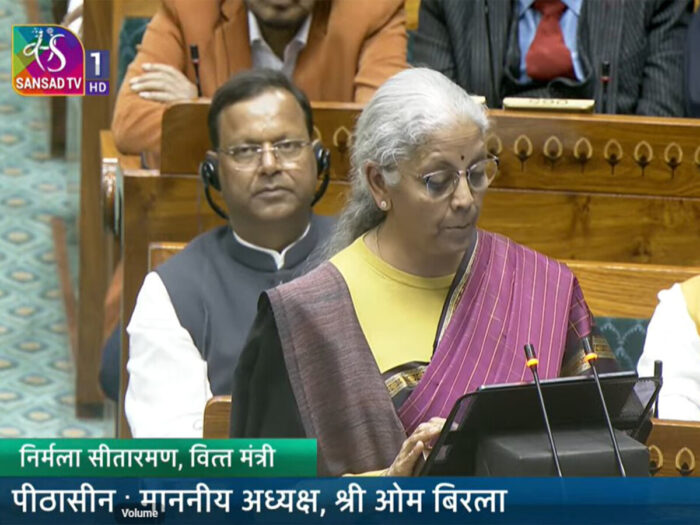
Picture Credit : Sansad TV
The Economic Survey 2025-2026 tabled in Parliament on January 29, 2026, it has set the stage for the upcoming Union Budget 2026, offering a detailed snapshot of India’s economic performance, challenges and outlook ahead of the Budget speech. The survey highlights India’s economy to be expected to grow around 7.4% in the current year, and is projected to expand between 6.8% and 7.2% in FY27, underlining steady growth despite global uncertainties.
Against this backdrop, expectations across key sectors are taking shape as stakeholders look to the Budget for support that sustains growth, strengthens jobs and eases financial pressures.
In the upcoming Union Budget 2026, food security will be a key issue the government would look to address. Even though Indian food security policy has strengthened in recent years through schemes such as the National Food Security Act (2013), PM Garib Kalyan Anna Yojana, PM POSHAN and Antyodaya Anna Yojana, the food supply chain has many challenges. Rising climate risks, reliance on imports for edible oils and pulses and persistent malnutrition among children indicate that the next leap should come from structural reforms for agriculture resilience in India.
The government’s ongoing missions, such as the National Mission on Edible Oils–Oilseeds (NMEO-Oilseeds) and the Aatmanirbharta in Pulses Mission, highlight a clear push toward self-reliance. Budget 2026–27 must strengthen these efforts, especially because India still imports a significant share of its edible oil (India currently imports 60% of its edible oil requirement) and pulses. Improving domestic capacity is not just an economic goal; it is essential to enable long-term food security.
The start-up ecosystem expects incentives around employee stock options and capital access, along with regulatory tweaks that encourage risk capital and talent retention without increasing compliance burdens. “As India’s IT services industry and GCC ecosystem continue to scale, the upcoming Union Budget presents an opportunity to reinforce the fundamentals that enable consistent, high-quality delivery. Continued investment in secure, reliable digital and physical infrastructure will further strengthen India’s position as a preferred destination for global capability centres and long-term client programs. In parallel, clear policy direction on AI adoption and workforce readiness will be critical to building a world-class, innovation-driven engineering talent base that can deliver sustained value with confidence and predictability” said Girish Hirde, Global Delivery Head at InfoVision.
Budget must fix inverted GST, back electric motorcycles to unlock mass EV Adoption. The Union Budget 2026-27 is seen as a vital opportunity to strengthen India’s electric mobility journey. While 2025 was a landmark year with EV sales reaching a record 2.3 million units, anchored by 1.28 million two-wheelers, the industry’s long-term health depends on structural tax reforms. A primary concern for domestic manufacturers is the inverted tax structure. While finished EVs attract a 5% GST, the raw materials sourced to build these vehicles are taxed at 18%. This 13% disparity traps vital working capital across the industry, driving up production costs and straining liquidity. Aligning the GST on all EV components to a uniform 5% is essential to support domestic manufacturing and make ‘Make-in-India’ EVs more affordable for the mass market. Furthermore, we believe the next wave of adoption will be led by electric motorcycles. While scooters have seen early success, motorcycles dominate with nearly 70% of India’s two-wheeler landscape but remain significantly under-electrified. To achieve our national 2030 targets, the budget should introduce targeted subsidies and demand incentives specifically for electric motorcycles. Prioritizing this dominant segment will unlock the next level of mass-market electrification and move India closer to a truly self-reliant EV ecosystem”, said Madhumita Agrawal, Founder and CEO of Oben Electric.
Another is the EPC sector which continues to be a key enabler of nation building, with sustained government investments driving tangible improvements in infrastructure outcomes across the country. We expect continued focus on large-scale infrastructure, with higher allocations for urban development in Tier 2 and Tier 3 cities, which are emerging as key growth drivers. Beyond core public works, focused investments in integrated industrial ecosystems will be critical to attract global enterprises and support large-scale manufacturing and infrastructure development. Export-focused support such as stronger credit and risk guarantees will encourage Indian EPC companies in scaling overseas projects and competing globally.
On the Logistics industry front, a Logistics Sector Skill Council budget poll has called for a 40 per cent hike in AI skilling investment in the forthcoming General Budget to boost employment in the country. The recommendation is set to accelerate the government’s mission to make India’s workforce future-ready and globally competitive. The Logistics Sector Skill Council’s latest budget poll covering 10 cities and 160 companies called for a 40 per cent increase in investments for AI-driven skilling and training to boost job generation.
With industrial output and investment showing resilience, firms are looking for policies that bolster capital formation, ease compliance, and expand infrastructure spending — especially in manufacturing and technology-driven sectors that promise jobs and exports.