Opinion
The BRICS Summit: A Big Diplomatic Success With Wait-and-watch Strategy
Russia’s rhetoric in New Delhi was, interestingly, also calibrated. President Vladimir Putin told the BRICS Business Forum: “We’re not against anyone.” He added that Russia was prepared to work with “all of our partners, old ones and new ones”. China, meanwhile, used the summit to call for a larger diplomatic role for BRICS


Picture : @MEAIndia/X
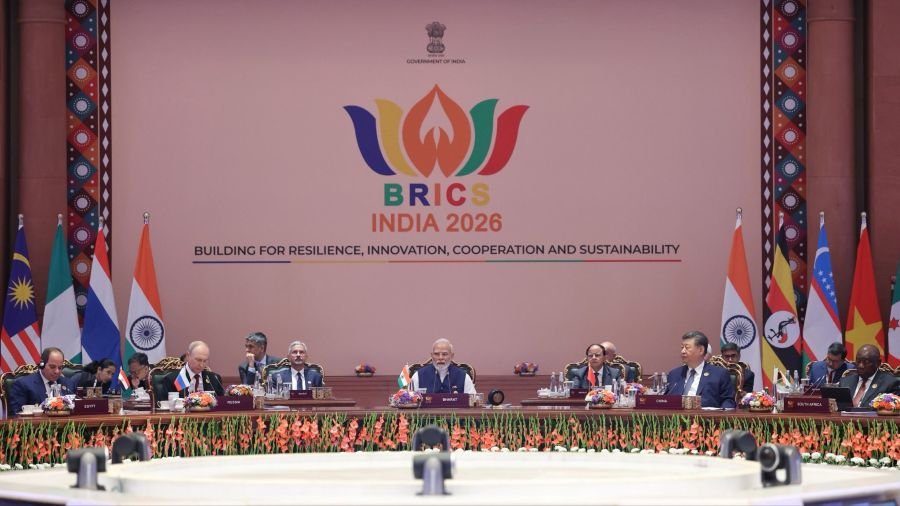
The 18th BRICS Summit hosted by India in New Delhi recently under the theme “Building for Resilience, Innovation, Cooperation and Sustainability” saw a successful closure with the New Delhi Declaration adopted at the Summit as a “significant diplomatic achievement” for India, particularly after the grouping struggled to issue a joint statement at the foreign minister-level meeting earlier this year.

Picture : @MEAIndia/X
India had to navigate several challenges, including the war in Iran and the policies of the United States. However, a few references in the declaration to disruptions in the global trade regime, US tariffs and US sanctions could lead to some unhappiness within the US administration.
The BRICS countries adopted the New Delhi Declaration 2026, calling for an immediate end to unilateral economic sanctions and expressing grave concern over rising protectionist policies. The declaration said the global multilateral trading system had reached a critical crossroads, with increasing trade-restrictive measures that violate World Trade Organisation rules. The grouping said sudden increases in customs duties, non-tariff barriers and protectionist restrictions disguised as environmental measures threaten international commerce, fuel economic uncertainty and deepen disparities between countries.
New Delhi Declaration gets adopted unanimously! https://t.co/nUNsBTwtPL
— Randhir Jaiswal (@MEAIndia) September 12, 2026
BRICS agreed to work towards making the WTO more responsive to trade disruptions while prioritising the economic and development needs of emerging markets and developing countries.
The declaration strongly condemned unilateral and secondary sanctions imposed outside the mandate of the UN Security Council, saying such measures violate international law and the UN Charter and have negative consequences for food security, healthcare and economic development.
Brics further backed WTO reform and called for a stronger, open, equitable, transparent, fair, inclusive, predictable and rules-based multilateral trading system, with the WTO at its core. It also advocated the immediate restoration of an accessible, effective and fully functioning two-tier binding WTO dispute settlement mechanism and called for the appointment of new Appellate Body members without further delay.
BRICS leaders have voiced serious concern over “deliberate attacks” on civilian infrastructure and peaceful nuclear facilities under full safeguards of the International Atomic Energy Agency (IAEA), underlining that nuclear safety must always be upheld, including in “armed conflicts”.
Prime Minister Narendra Modi announced the adoption of the declaration at the end of the opening day’s deliberations in the presence of Chinese President Xi Jinping, Russian President Vladimir Putin, Iranian President Masoud Pezeshkian, Abu Dhabi Crown Prince Mohamed bin Zayed Al Nahyan and other top leaders of the bloc.
The Declaration condemns unilateral coercive measures as violations of international law, calls for protecting global trade, energy flows and supply chains, demands an end to the blockade against Cuba, and voices concern over the escalating tensions in West Asia — all while avoiding direct mention of specific countries.
Russia’s rhetoric in New Delhi was, interestingly, also calibrated. President Vladimir Putin told the BRICS Business Forum: “We’re not against anyone.” He added that Russia was prepared to work with “all of our partners, old ones and new ones”. China, meanwhile, used the summit to call for a larger diplomatic role for BRICS. President Xi Jinping urged the grouping to contribute to peace-making in West Asia and confirmed that China will assume the BRICS chairmanship and host the next summit in 2027.
A moment of unity and shared purpose as BRICS Leaders come together for the family photo at the 18th BRICS Summit in New Delhi.#BRICS2026 #BRICSIndia2026 #IndiaBRICSChairship pic.twitter.com/Am162NLP3j
— Randhir Jaiswal (@MEAIndia) September 12, 2026
The New Delhi consensus nevertheless should not be confused with strategic convergence. BRICS remains an extraordinarily heterogeneous grouping. India and China are strategic competitors despite their improving dialogue. Iran faces Western sanctions and is directly involved in the West Asian confrontation, while the UAE has very different security and commercial relationships. India maintains deep strategic partnerships with the United States and Europe even while sustaining its longstanding relationship with Russia.