Opinion
Scripting History : BJP’s Stunning Victory Ensures West Bengal Finally Turns Saffron
The BJP leadership is now focussed on rebuilding Bengal’s lost stature. Since the Tata Nano project left Singur for Gujarat, Bengal has struggled to attract large-scale industrial investment. One of the biggest barriers, according to the new government, remains land acquisition. The BJP government is now expected to review and possibly relax certain policies to encourage industrialisation.


Picture Credit : @BJP4Bengal/X
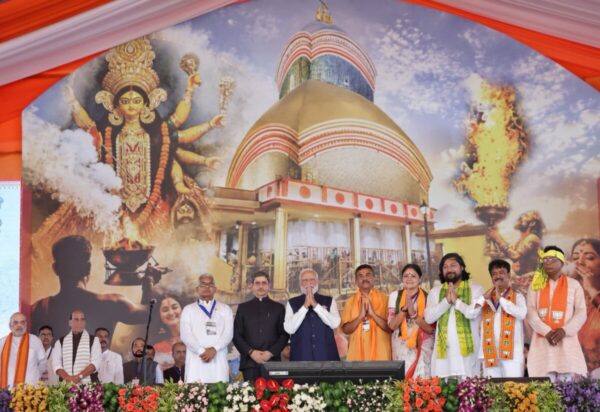
When Suvendu Adhikari took oath as West Bengal’s first BJP Chief Minister on Rabindra Jayanti on May 9, the Brigade ground turned saffron, roaring with ‘Jai Shree Ram’ slogans. A scene impossible to imagine just a few days ago had now become a reality, announcing the new change of guard in West Bengal with a thunderous welcome to the BJP leadership. After a long and intense election campaign built around Hindutva, border security, Bengali identity and development politics, the choice of Rabindranath Tagore’s birth anniversary for the swearing-in ceremony appears to be a carefully crafted political message.
BJP’s victory in the West Bengal assembly elections has been widely described as a tectonic shift—only the second change in power in the state in the last 50 years. Both transitions are significant: the first ended 34 years of rule by the socialist Left Front, while the second has now replaced the centrist Trinamool Congress (TMC) with the right-wing BJP, a party rooted in Hindutva politics.
BJP’s ideological forebear, Shyama Prasad Mukherjee, who was associated with the Hindu Mahasabha and Jana Sangh, hailed from West Bengal. It is, therefore, unsurprising that BJP’s state leadership marked its victory by paying homage to him, underscoring the symbolic significance of this political shift.
𝐇𝐢𝐬𝐭𝐨𝐫𝐢𝐜 𝐝𝐚𝐰𝐧 𝐢𝐧 𝐁𝐞𝐧𝐠𝐚𝐥: 𝐀 𝐧𝐞𝐰 𝐜𝐡𝐚𝐩𝐭𝐞𝐫 𝐮𝐧𝐟𝐨𝐥𝐝𝐬.
On May 9, 2026, Kolkata’s iconic Brigade Parade Ground witnessed a landmark moment as the BJP formed its first government in West Bengal. With Shri Suvendu Adhikari taking the oath as Chief… pic.twitter.com/hag9jyXUN5
— BJP (@BJP4India) May 9, 2026
This election saw the BJP increasingly adapting its political language to Bengal’s cultural ethos, blending symbolism around fish, Durga and Kali with promises of economic revival, women-centric messaging and its sharper focus on border security and infiltration. The party’s rise reflects an attempt to localise Hindutva within Bengal’s distinct cultural identity. Whether this vision becomes reality or remains political rhetoric will depend on what happens in the years to come. But, for now, the BJP leadership is presenting the beginning of the Suvendu Adhikari era not merely as a change in government but as the opening chapter of what they call Bengal’s “second renaissance”.
পশ্চিমবঙ্গের মুখ্যমন্ত্রী হিসেবে শপথ গ্রহণ করায় শ্রী শুভেন্দু অধিকারী জি-কে অভিনন্দন। তিনি জনগণের সঙ্গে ঘনিষ্টভাবে সংযুক্ত একজন নেতা হিসেবে নিজের পরিচয় তৈরি করেছেন। তাঁদের আশা-আকাঙ্ক্ষাকে তিনি খুব কাছ থেকে জেনেছেন। তাঁর ভবিষ্যতের সফল কার্যকালের জন্য তাঁকে আমার অনেক অনেক… pic.twitter.com/UhrI5ljiAZ
— Narendra Modi (@narendramodi) May 9, 2026
Prime Minister Narendra Modi seeks to bring this renaissance in Bengal through a blend of cultural revivalism, sanatani civilisational identity and economic modernisation. West Bengal had already witnessed one historic political transformation in 2011, when power shifted from the Left Front to the Trinamool Congress. The state changed from “red to green”.
One of Adhikari’s first symbolic decisions has been to shift the administrative headquarters back to the Writers’ Building from Nabanna. The colonial-era structure remains deeply tied to Bengal’s political memory under British rule.
The BJP leadership is now focussed on rebuilding Bengal’s lost stature. Since the Tata Nano project left Singur for Gujarat, Bengal has struggled to attract large-scale industrial investment. One of the biggest barriers, according to the new government, remains land acquisition. The BJP government is now expected to review and possibly relax certain policies to encourage industrialisation.
The BJP has maintained that Bengal requires not only economic recovery but also a cultural and psychological reset, while preventing the continuation of a “bad CPM culture”.
Celebrating the victory, Modi emphasised that it was “a time for change, not revenge.” His campaign centred on transformation, though a dominant theme was the issue of so-called “infiltration,” portrayed as a root cause of problems such as unemployment, crime, cross-border smuggling, and security threats. These concerns were frequently linked to migration across the eastern border with Bangladesh. BJP has pledged to curb such “infiltration” and expel those it identifies as “illegal migrants.”
One of the key policies of the BJP government on this issue is to grant citizenship to those who belong to all other faiths except Islam, and Bangla-speaking Muslims are the most vulnerable to possible deportation, as there have been several reports of such deportation of Indian nationals to Bangladesh in recent times.
With such a landslide victory, a lot of responsibility lies on BJP’s shoulder to revive Bengal’s lost glory as a state with rich cultural, intellectual and economic heritage rather than a state became infamous of notoriety in recent years. It’s a tough task for BJP, but efforts should be made to accomplish them at all cost in order to justify the public’s faith which the voters had put in them.