Opinion
Bangladesh Election Results: Will BNP Extend The Same Warmth As Awami League
India would like to put the upheaval of the past 18 months, including uncertainty caused by Bangladesh flirting with China and Pakistan, and the killing of Hindu minorities, and establish a stable working relationship that ensures a decades-old ally remains by its side


Picture Credit : @tariquebd78/X
·
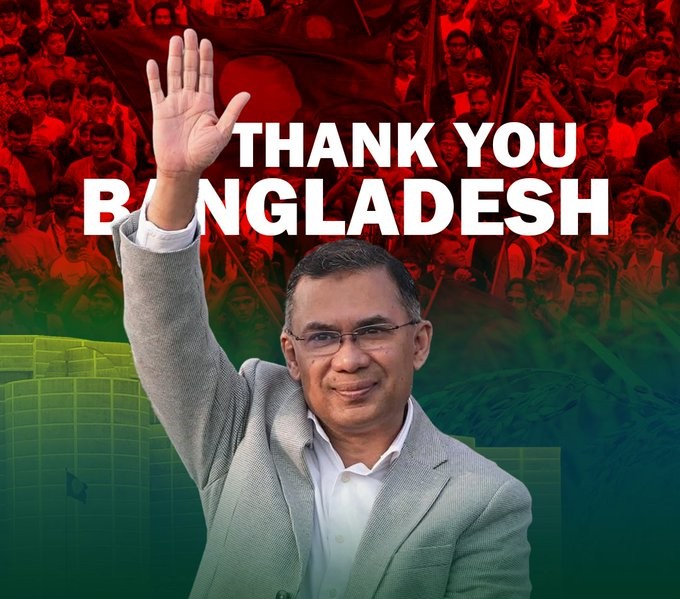
Being in a state of turmoil for more than a year, Bangladesh heaved a sigh of relief with general elections finally happening. Though, the results were much to the public anticipation with former Prime Minister Sheikh Hasina led party, Awami League being out of the race, people of Bangladesh gave a thunderous welcome to Tarique Rahman with a historic win. Rahman-led centre-right Bangladesh Nationalist Party(BNP) won a two-thirds majority in the 300-member Parliament. In the absence of Hasina’s Awami League, the results were also a boost to the Islamist Jamaat, whose share of seats rose manifold — from its earlier record of 18 seats in 1991 to more than 60 this time.
Congratulations to the Bangladesh Nationalist Party and its leader Tarique Rahman as well as the people of Bangladesh. The United States looks forward to working with the newly elected government to advance prosperity and the security of the region.
— Secretary Marco Rubio (@SecRubio) February 13, 2026
Prime Minster Narendra Modi congratulated Rahman for the “decisive victory” in a post on X, “This victory shows the trust of the people of Bangladesh in your leadership. India will continue to stand in support of a democratic, progressive and inclusive Bangladesh.” The quick response is indicative of the BNP’s win appearing to be a foregone conclusion, as well as India’s intentions to engage with the new government.
I convey my warm congratulations to Mr. Tarique Rahman on leading BNP to a decisive victory in the Parliamentary elections in Bangladesh.
This victory shows the trust of the people of Bangladesh in your leadership.
India will continue to stand in support of a democratic,…
— Narendra Modi (@narendramodi) February 13, 2026
I extend my warmest felicitations to Mr. Tarique Rahman on leading the BNP to a resounding victory in the Parliamentary elections in Bangladesh. I also congratulate the people of Bangladesh on the successful conduct of the elections.
I look forward to working closely with the…
— Shehbaz Sharif (@CMShehbaz) February 13, 2026
India had also reached out to Rahman after Khaleda Zia’s death, with External Affairs Minister S Jaishankar travelling to Dhaka in December to convey condolences and attend her funeral. The gesture helped the state of bilateral relations, and Rahman or any top BNP leaders did not make any India-critical statements during the election campaign. Even upon his return to Bangladesh, when Rahman received a hero’s welcome last year, he struck a conciliatory tone in his public speech. “We have people from the hills and the plains in this country: Muslims, Hindus, Buddhists and Christians. We want to build a safe Bangladesh, where every woman, man and child can leave home safely,” he said.
India would like to put the upheaval of the past 18 months, including uncertainty caused by Bangladesh flirting with China and Pakistan, and the killing of Hindu minorities, and establish a stable working relationship that ensures a decades-old ally remains by its side. India has monitored this election closely because which way the new government swings could shift regional geopolitics in South Asia and beyond, and impact national security. From Delhi’s perspective there are three inter-connected issues, the biggest of which is a potential Pakistan-China-Bangladesh axis – a possibility if Rahman’s incoming administration has a foreign policy that is less kindly disposed to Delhi than that led by Hasina. A Pak-China-Bangladesh nexus could weaken Delhi’s hold on South Asia.
India faces a few challenges with the change of guard in Bangladesh. Firstly, there is the pressing issue of Hasina remaining in India. The BNP chief will face criticism from the Jamaat if it doesn’t press for her extradition. He would also not want Hasina to make politically provocative statements from India. Secondly, the economic ties are crucial for both sides. Bangladesh is India’s largest trading partner in South Asia, covering sectors like textiles and energy. Among many other, a key issue of the huge economic migration from Bangladesh to India will be under watch. The issue of Bangladeshi immigration has already become a political issue in several Indian states, often raised as part of the BJP’s political platform. It must be managed amicably and sensitively. Also, India would not want an extremist and anti-minority turn in Bangladesh society, and it would be in the BNP’s interest to keep those elements under check. Statements from Delhi about the recent spate of attacks on Hindus and religious minorities can only go so far, and it is the leaders in Bangladesh who must match that sentiment. Ensuring cooperation in these areas can cumulatively help prevent Bangladesh from turning towards Pakistan or China.