Books
Work in Progress: An Economic Analysis of the Modi Decade 2014–24 By Rajiv Kumar, Srinath Sridharan
The book looks at the economy the Modi government inherited in 2014 and tracks the decade across GDP growth, inflation, employment, private investment, infrastructure, the external sector, human development and sustainability. It acknowledges major shifts in infrastructure creation, digital connectivity, welfare delivery and macroeconomic resilience, while interrogating persistent challenges such as youth employment, weak private investment, manufacturing, institutional capacity and the gap between access and actual opportunity.

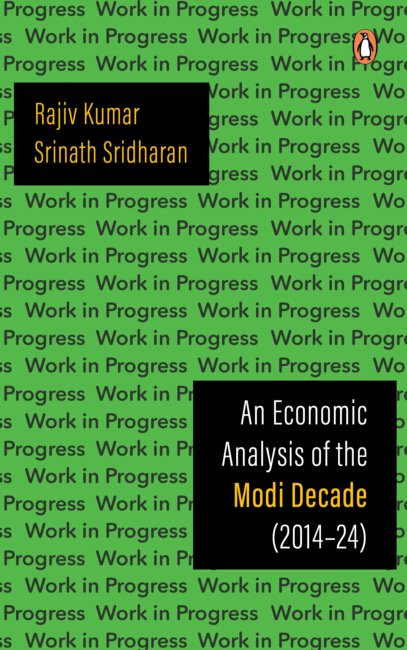

How should the decade from 2014 to 2024 be remembered economically? Did India fundamentally strengthen its economy, or do the biggest challenges around jobs, private investment, human development and institutional capacity remain unresolved?
In Work in Progress: An Economic Analysis of the Modi Decade (2014–24), economists and policy commentators Rajiv Kumar and Srinath Sridharan offer a detailed, evidence-based assessment of one of the most consequential decades in India’s recent economic history. Rather than viewing the period through a purely political lens, the authors examine what the numbers tell us about India’s transformation and, equally importantly, what remains unfinished.
The book looks at the economy the Modi government inherited in 2014 and tracks the decade across GDP growth, inflation, employment, private investment, infrastructure, the external sector, human development and sustainability. It acknowledges major shifts in infrastructure creation, digital connectivity, welfare delivery and macroeconomic resilience, while interrogating persistent challenges such as youth employment, weak private investment, manufacturing, institutional capacity and the gap between access and actual opportunity.
One of the central arguments of the book is that India cannot evaluate its progress simply through headline GDP growth or infrastructure creation. The more important question is whether economic expansion is translating into productive employment, stronger institutions, greater agency and better quality of life. The authors argue that India’s transformation is real, but uneven and incomplete, making the country quite literally a “work in progress”.
As India looks towards Viksit Bharat, the authors also turn the conversation forward: What must India do differently in the next decade? Can it revive private investment? Can growth create enough productive jobs? Can India turn its demographic and digital advantages into higher productivity and innovation? And can the country reconcile economic ambition with social equity and ecological sustainability?
How should the decade with Narendra Modi as prime minister be remembered?
Few periods in India’s post-Independence history have been as eventful, contested and consequential as the decade from 2014 to 2024. It changed the way India approached economic growth, infrastructure, social protection, sustainability and access to opportunity, while also revealing the distance between access and agency, physical expansion and institutional capability, and national ambition and lived experience.
Drawing on data and the authors’ decades of experience across policy, business and public institutions, Work in Progress takes stock of this defining decade, examining what changed and what India’s gains and gaps tell us about the road ahead.
As India moves towards Viksit Bharat, the next phase, or the desirable decade, will depend on its ability to translate its demographic, financial and digital strengths into jobs, investment, productivity and innovation. It will also require navigating a changing global economy, technological disruption and climate pressures, while ensuring that growth delivers greater inclusion, mobility and quality of living. The answers will also shape the kind of developed India that emerges.
Author Bios:
Rajiv Kumar
Dr Rajiv Kumar is a distinguished economist and policy expert, and former Vice Chairman of NITI Aayog (2017–2022), where he held Cabinet rank. He is the founder and Chairman of Pahle India Foundation, a policy think tank established in 2013. His career spans academia, government, corporate chambers, and multilateral institutions, including roles as Economic Advisor in the Ministry of Finance (1991–1995), Chief Economist at CII, and Secretary General of FICCI. Dr. Kumar holds a Ph.D. from Lucknow University and a D.Phil. from Oxford. In 2023, he was awarded Japan’s Order of the Rising Sun for strengthening India–Japan economic ties.
Srinath Sridharan
Srinath Sridharan is a strategic counsel to leading corporates, boards and promoters, with over three decades of experience spanning transformation, succession planning, governance and business scaling. He serves as an independent director across multiple industries and is a CEO coach, working with leaders on strategy, leadership and institutional effectiveness. He is the author of several books and a prolific columnist. A sought-after thought leader, he frequently addresses corporate boards, family councils and global investors on critical issues.
Imprint: Penguin Business
Published: Dec/2026
ISBN: 9789377307325 (Hardback)
Length : 352 Pages
MRP : ₹799.00