Books
Why Kenyans Win Marathons and Estonians Build Unicorns By Anirudh Krishna
More than a decade ago, Anirudh Krishna began tracking these flows of excellence and found that the standard explanations of genetics or geography don’t hold up. Excellence is not tied to any given ethnicity, legacy, or political system. Replicable ingredients drive it specifically, an infrastructure of opportunity that promotes near-universal participation.

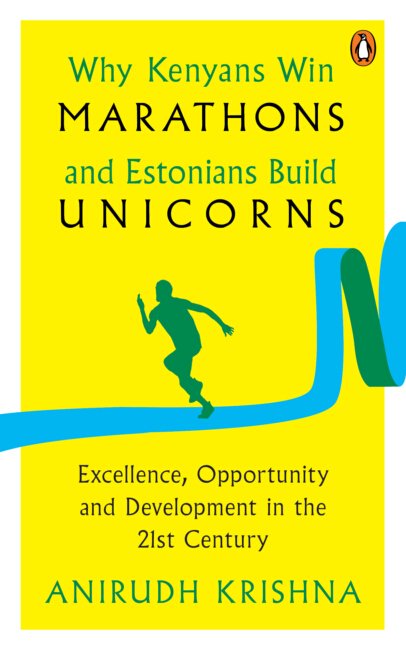

Why do people from certain countries excel at particular activities?
Why do so many of the world’s best long-distance runners come from Kenya? How does Estonia (pop: 1.3 million) produce so many tech unicorns—Skype, Bolt, Wise? Why do so many distinguished writers come from Nigeria and so many classical musicians from Venezuela?
More than a decade ago, Anirudh Krishna began tracking these flows of excellence and found that the standard explanations of genetics or geography don’t hold up. Excellence is not tied to any given ethnicity, legacy, or political system. Replicable ingredients drive it specifically, an infrastructure of opportunity that promotes near-universal participation.
This book uncovers how societies identify talent, create opportunity, and combine them into systems that consistently deliver the best.
Contrarian in approach and rigorous in research, it doesn’t just explain success it builds a framework for replicating egalitarian structures that broaden opportunity and deliver excellence.
Author Bio:
Anirudh Krishna is the Edgar T. Thompson Professor of Public Policy at Duke University, USA. For more than twenty-five years he has been researching how individuals move ahead and societies flourish. His most recent book, The Broken Ladder: The Paradox and the Potential of India’s One Billion, won the Ananda K. Coomaraswamy Award of the Association of Asian Studies.
Imprint: India Viking
Published: Jul/2026
ISBN: 9789377300838 (Hardback)
Length : 264 Pages
MRP : ₹699.00