Books
THE YELLOW METAPHOR By Jiban Narah
Spanning more than thirty years, 1990 and 2023, The Yellow Metaphor traces the journey of a poet shaped by bilingual and bicultural inheritance. Born in a village along the Brahmaputra, Narah writes from a region often described as India’s “eastern edge.”

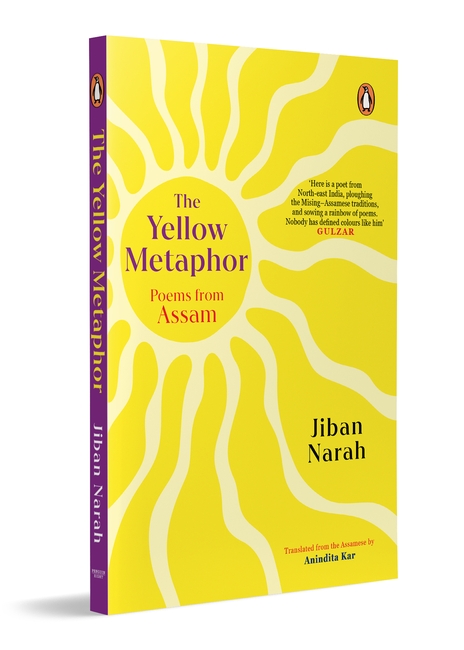

The Yellow Metaphor, a landmark poetry collection gathering over three decades of work by Jiban Narah, one of Assam’s most original and influential literary voices, translated into English for the first time by Anindita Kar. The poems trace how identity, belonging, grief, and cultural inheritance emerge from landscape, community, and lived history.
Rooted in Mising and Assamese life, Narah’s poetry rises from landscapes shaped by rivers, floods, and folklore. The Brahmaputra flows through these poems not simply as a backdrop but as a living presence, shaping memory, myth, politics, desire, and everyday survival. At the heart of the collection is the recurring presence of the color yellow, appearing in mustard fields, lingering eyes, and laboring skin. Yellow dazzles and unsettles, becoming a way of seeing the world at its brightest and most vulnerable.
Spanning more than thirty years, 1990 and 2023, The Yellow Metaphor traces the journey of a poet shaped by bilingual and bicultural inheritance. Born in a village along the Brahmaputra, Narah writes from a region often described as India’s “eastern edge.” Yet his poems resist marginality: they speak from within folk beliefs, indigenous culture, and collective memory, positioning Assam and the North-East not as subjects but as sources of literary imagination.
For English readers, this is a rare chance to experience the vibrancy of North-East India’s contemporary literary imagination.
From the heart of Assam, these poems rise like mist over the Brahmaputra—intimate, insurgent, and timeless.
The Yellow Metaphor is both a landmark translation and a living archive of poetic vision. Carrying the rhythms of river life, the weight of history, and the brightness of imagination, these poems move across languages and generations, flowing onward, like the Brahmaputra itself.
Why This Book Matters:
A Major Assamese Voice in English – Bringing over thirty years of Narah’s poetry into English, this collection marks a significant moment for contemporary Indian poetry in translation.
Poetry as Cultural Passage – Anindita Kar’s translation preserves linguistic texture, indigenous imagery, and cultural depth, allowing Assamese and Mising worlds to remain present on the page.
A poetic geography shaped by the Brahmaputra – Deeply rooted in North-East India, the collection foregrounds the river as a literary anchor, offering a vision of how regional voices are reshaping global literary conversations.
Land, Identity, and Belonging – Themes of homeland, memory, desire, and cultural inheritance run through every poem, creating a literary archive of North-East India’s lived realities.
Praise for the Book:
“Here is a poet from North-east India, ploughing the Mising–Assamese traditions, and sowing a rainbow of poems. Nobody has defined colours like him.” – Gulzar
About the Author:
Jiban Narah is a poet, novelist, teacher, and one of Assam’s most original literary voices. His work has been translated into Bengali, Hindi, Manipuri, Marathi, Oriya, Gujarati, and Tamil. Earlier English collections include The Orange Hill and The Buddha and Other Poems.
About the Translator:
Anindita Kar specializes in translating Assamese and Bengali literature into English, bringing contemporary voices from India’s North-East to a wider readership while preserving the poetry’s cultural and linguistic texture.