National
Supreme Court To Examine Whether They Was Split In The Shiv Sena ; CJI Led Bench Makes These Observations During Final Hearing Of Pleas By Shiv Sena(UBT) And Eknath Shinde faction
The observations were made by a bench comprising Chief Justice Surya Kant and justices Joymalya Bagchi and V Mohana during the final hearing on the pleas by the Uddhav Thackeray faction to the Election Commission’s decision recognising the Eknath Shinde-led faction as the original Shiv Sena and allotting it the party’s name and the ‘bow and arrow’ symbol.


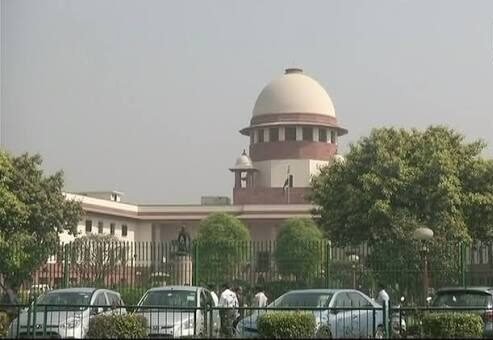
File Picture : ANI/X
The Supreme Court has said that it will have to first see whether there had been a split in the Shiv Sena as such a division may originate in the legislature party and the fissure can percolate into the organisation and the primary membership.
The observations were made by a bench comprising Chief Justice Surya Kant and justices Joymalya Bagchi and V Mohana during the final hearing on the pleas by the Uddhav Thackeray faction to the Election Commission’s decision recognising the Eknath Shinde-led faction as the original Shiv Sena and allotting it the party’s name and the ‘bow and arrow’ symbol.
During the hearing on the fourth day, Justice Bagchi said, “First, we have to see whether there is a split. A split may originate in the legislature party, but the fissure can percolate into the organisation and the primary membership.”
To this, senior advocate Kapil Sibal, appearing for the Uddhav faction, said, “As a proposition of law, a split in the political party can never arise merely from a split in the legislature party. That has been decided by the Constitution Bench (in a judgment).”
Justice Bagchi said the judgment says that the proposed split cannot be restricted to a split in the legislature party.
“But it does not say that if a split begins in the legislature party and subsequently gets reflected in the organisation and the primary membership, it cannot be considered. It may be the epicentre of a larger split,” the judge said.
Sibal said the judgement does not speak of the legislature party. The bench said it needed clarity on this aspect.
“The Shinde group had the support of 11 ‘Rajya Prabharis’. A Rajya Prabhari is part of the party structure. It is not something outside the Shiv Sena’s organisational structure. More importantly, when we consider a political party, we are not concerned only with office-bearers. We also have to consider the primary membership,” the bench said.
Sibal questioned the Election Commission’s approach in determining whether there was a genuine dispute within the party and whether the faction approaching it had exhausted the internal remedies available under the Shiv Sena’s constitution.
He said that the Commission’s reasoning effectively required a faction to pursue internal remedies even when the rival group had already moved to another location, formed a government and had itself acted contrary to the party constitution.