Books
Q&A: Simple thinking is about bringing clarity to complexity. It means breaking a difficult problem into smaller parts, questioning assumptions, and focusing on what truly matters rather than getting overwhelmed by information and noise – Mukesh Sud
Simple thinking is less about intelligence and more about habits.One habit is learning to ask better questions. Instead of asking “How do I solve everything?”, ask “What is the real problem?”



In this insightful Q&A, Mukesh Sud explains how breaking complex challenges into smaller parts and questioning assumptions leads to better decision-making.
We are obsessed with complexity and constantly seek elaborate responses to overcome challenges. The Power of Simple Thinking offers an alternate way to look at problems. Remember simplicity isn’t the absence of sophistication, rather it is finding clarity amidst chaos. If you are overwhelmed with clutter, see how a shift to simplicity can reduce outside noise and unlock smarter solutions.
A prolific writer Mukesh Sud had earlier won critical acclaim for his book which he co-authored , Leapfrog: Six Practices to Thrive, is a national bestseller and has been translated into many languages. Here in a candid conversation he talks about his latest book that is making headlines and much more.
Excerpts :
Q :In a world today that appears to be adrift can Simple Thinking resolve the pressing issues at hand ?
A : The world is undeniably complex. Climate change, geopolitical conflict, technological disruption and inequality cannot be solved by simplistic answers. But there is an important distinction between simple and simplistic.
Simple thinking is about bringing clarity to complexity. It means breaking a difficult problem into smaller parts, questioning assumptions, and focusing on what truly matters rather than getting overwhelmed by information and noise.
History repeatedly shows that many breakthrough solutions were surprisingly simple once someone saw the problem differently. Whether it is Mumbai’s dabbawalas, the FBI’s hostage negotiators, or even nature’s own systems like ant colonies, simple rules often outperform complicated ones.
Q :. The Power of Simple Thinking offers an alternate way to look at problem as your book says. Can you tell us what are the ways ahead?
A : Most of us assume difficult problems require equally complicated answers. Often the opposite is true. The approach I suggest has three parts. First, simplify the problem by breaking it into manageable pieces.
Second, adopt what is called a paradoxical mindset. Many challenges require us to embrace seemingly opposing ideas rather than choosing one over the other. For example, you can be disciplined and flexible, ambitious and patient, confident and curious at the same time.
Finally, pay attention to the obvious things that everyone else ignores. Sherlock Holmes succeeded not because he saw extraordinary clues, but because he noticed ordinary ones that others overlooked.
Q : What can an individual achieve by simple thinking if his world is unplanned and in chaos.
A: It is in a chaotic situation that simple thinking becomes most valuable. When everything feels uncertain, our instinct is often to seek more information, make more plans and create more complexity. That usually increases anxiety.
Simple thinking encourages us to ask a different question: What is the next simple thing I can do? Small actions build momentum. In the book I share stories of entrepreneurs, athletes, negotiators and ordinary individuals who achieved remarkable outcomes not because they tried to conrol everything around them but because they focused on the few things they could influence.
Q : Can you elaborate on the ways one needs to adopt to achieve simple thinking
A: Simple thinking is less about intelligence and more about habits.One habit is learning to ask better questions. Instead of asking “How do I solve everything?”, ask “What is the real problem?”
Another is embracing constraints. We often think constraints limit creativity, but they frequently stimulate it. Many innovations emerge because resources are limited. Other habits involve accepting paradoxes and remaining curious.
Q: There is a lot of outside noise courtesy of social media. Do you think simple thinking can be attained in such a scenario ?
A: It is not only social media there are a lot of confusing signals all around us. For that we need to be able to curate and separate the signal from the noise and focus on what really matters.
Q: Any particular reason for naming the title of your book – Simple Thinking – tackling problems with simplicity. Was it your choice or of the publisher ?
A: It’s always bouncing ideas of each other. Many years ago I read a book Simple Rules written by two academics from Stanford University. It left a lasting impression and lead to my title.
Q : How can one solve problems by simplicity? Can you please elaborate .
A : Complex problems usually become intimidating because we try to solve them all at once.Simple thinking asks us to separate the problem into smaller components. Take negotiation. The FBI discovered that listening carefully often achieved more than confrontation. Take food habits. Small changes in what and how we eat can dramatically improve long-term health.Simplicity doesn’t ignore complexity. It helps us navigate it more effectively.
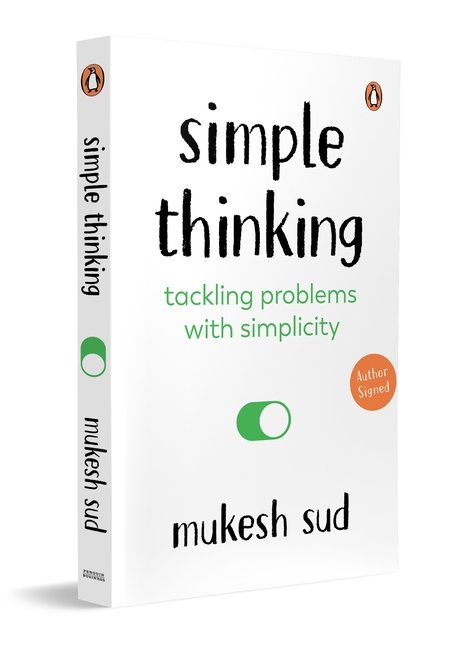

Q: Which book did you enjoy writing the most or rather excited you to write – LeanSpark , Leapfrog , or Simple Thinking .
A : All three have been fulfilling in different ways. The first two were joint efforts and I learnt a lot from co-authoring with colleagues who are now close friends. Simple Thinking of course is my baby.
Q : For aspiring writers what would be your message going ahead? What mantra should they adopt.
A : Just be at it. I know that might sound trite but showing up every day is the only way forward. An remember it’s never about the writing, it’s all about rewriting.
Q : As a prolific writer yourself what genre appeals to you most . And how has been the feedback from the audience in your journey so far ?
A : I love reading short stories. My work similarly draws from anecdotes and stories in the social sciences which describe true events and experiments that often remain tucked in journals. My job is to bring them to a wider audience.