Books
INDIA AFTER NON ALIGNMENT : The Quest to Become a Pole in International Politics By HAPPYMON JACOB
Happymon Jacob makes the hard claim that ‘nonalignment is dead’—but the instinct beneath it is not. India’s neutrality on Ukraine, restraint over Iran, simultaneous partnerships with Washington, Moscow and the Global South, and refusal to become anyone’s junior ally are, he argues, expressions of a deeper century-old ambition: to become an independent pole—a centre of power, norms and geopolitical agency in its own right

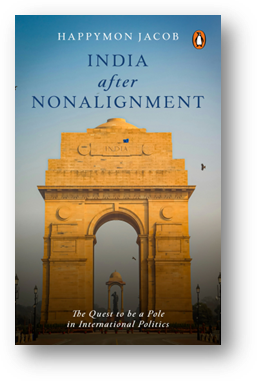

As India chairs BRICS, navigates the aftershocks of the 2026 Iran–Israel–United States conflict, manages a sharpening US–China rivalry and is increasingly asked to act as a bridge in a fractured world, a provocative new book argues that the old vocabulary no longer explains New Delhi. In India After Nonalignment: The Quest to Become a Pole in International Politics (Viking | Penguin Random House India), Happymon Jacob makes the hard claim that ‘nonalignment is dead’—but the instinct beneath it is not. India’s neutrality on Ukraine, restraint over Iran, simultaneous partnerships with Washington, Moscow and the Global South, and refusal to become anyone’s junior ally are, he argues, expressions of a deeper century-old ambition: to become an independent pole—a centre of power, norms and geopolitical agency in its own right. Jacob also introduces ‘functional multipolarity, a framework that judges a pole not simply by how much power it possesses, but by what it can actually do, where it can do it, and whether others recognise that role.
The book began with a very human failure to answer a familiar question. For nearly twenty years, Jacob had heard diplomats, scholars and visiting delegations ask, ‘What does India want?’ He thought the answer was obvious—until a 2022 conversation in Berlin, months into the Ukraine war, when German thinkers pressed him on how India could refuse to condemn Russia, buy Russian oil and deepen ties with Washington at the same time. Jacob realised that the standard labels—nonalignment, strategic autonomy, hedging, multialignment—described India’s behaviour but did not explain the ambition beneath it. On the flight home, the book took shape. Drawing on two decades inside India’s strategic community, including closed-door deliberations, Track 1.5 and Track 2 dialogues and conversations with practitioners, he developed what he calls the ‘Ecosystem Method’: treating the unwritten conversations and informal networks of a capital as evidence in a country that publishes no formal national security strategy or foreign-policy white paper.
About The Author
Happymon Jacob is the founder and director of the Council for Strategic and Defence Research (CSDR), Distinguished Visiting Professor at Shiv Nadar University, Delhi NCR, editor of India’s World magazine and a regular columnist for Hindustan Times. Before joining Shiv Nadar University, he spent seventeen years on the faculty of Jawaharlal Nehru University. His previous books include The Line of Control: Travelling with the Indian and Pakistani Armies (Penguin Viking, 2018) and Line on Fire: Ceasefire Violations and India–Pakistan Escalation Dynamics (Oxford University Press, 2019). A scholar of Indian foreign policy, strategic affairs and India–Pakistan relations, Jacob has spent years working at the intersection of scholarship and policy—including sustained Track 2 engagement—and India After Nonalignment brings that practitioner-scholar vantage point to the defining question of India’s rise: not merely how powerful India is becoming, but what kind of power it wants to be.