Books
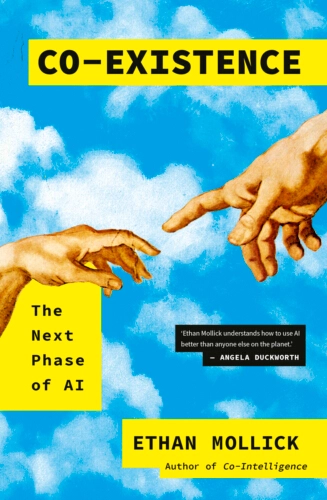
CO-EXISTENCE – THE NEXT PHASE OF AI By ETHAN MOLLICK
In his new book, Co-Existence, Mollick moves the AI conversation beyond the familiar question of “Will AI take our jobs?” Instead, he asks a more immediate one: How do we build careers, companies and lives when intelligence is no longer exclusively human?


AI can now do parts of your job better than you. So what are humans still for?
AI is no longer a technology we are preparing for. More than a billion people use it every week, and it can already write, reason, code, analyse, persuade and create. Yet its abilities remain remarkably uneven. An AI that performs brilliantly on a complex problem can stumble over something seemingly obvious.
Ethan Mollick, Wharton professor and bestselling author of Co-Intelligence, calls this uneven landscape the “jagged frontier”: the constantly shifting boundary between what humans do better, what AI does better, and where the greatest possibilities emerge when the two work together.
In his new book, Co-Existence, Mollick moves the AI conversation beyond the familiar question of “Will AI take our jobs?” Instead, he asks a more immediate one: How do we build careers, companies and lives when intelligence is no longer exclusively human?
The follow-up to the bestselling Co-Intelligence: a guide to thriving at the jagged frontier where human and AI capabilities collide.
AI isn’t coming—it’s already here. A billion people now use it every week. AIs can reason, plan, persuade, create, and collaborate in ways that once seemed impossible. Non-human intelligence is now embedded in nearly everything humans do.
But AI capability isn’t uniform. It’s jagged—a landscape of sharp peaks where AI excels beyond human ability and deep valleys where it fails at tasks a child could master. This unevenness creates profound confusion: the same system that writes elegant code might fabricate a simple fact or produce brilliant analysis while missing obvious context.
In his bestselling Co-Intelligence, Ethan Mollick—a Wharton professor and author of the widely read One Useful Thing newsletter—showed readers how to use AI productively. In this urgent sequel, he argues that the jagged frontier, for all its instability, is where the future will be decided. If AI were uniformly better or worse than humans, the outcome would be clear: total replacement or marginal utility. Instead, uneven capability creates volatile overlaps between human and machine strengths. Most work now spans peaks and valleys—and humans are still best equipped to navigate that terrain.
Clear, practical, and written with Mollick’s signature wit, Co-Existence is the essential guide for anyone who needs to understand not just how to work with AI—but how to thrive at the frontier where human and machine intelligence meet.