Books
BATTLEGROUND BENGAL : THE POLITICAL FUTURE OF A FIERCELY CONTESTED STATE By SAYANTAN GHOSH
Battleground Bengal is the culmination of a detailed examination of the state’s changing political landscape over the past decade. Drawing on the author’s eight-plus years of professional experience as a political correspondent and researcher, the book is built upon a foundation of electoral data, vivid reportage


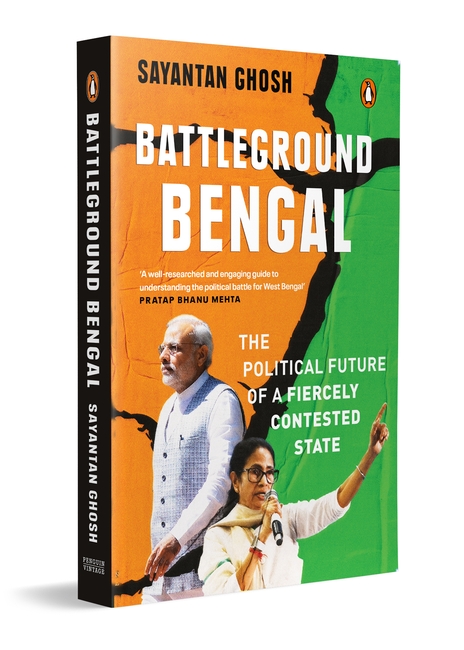
WHY THIS BOOK, WHY NOW
- The book lands less than a year before the 2026 Bengal assembly election, widely seen as Mamata Banerjee’s toughest political test.
- It comes after the Supreme Court upheld the cancellation of 25,000 teaching and non-teaching jobs linked to the School Service Commission scam.
- It documents how allegations of corruption, central-agency probes, and political violence have reshaped voter behaviour across districts.
- This book examines how the Election Commission of India’s Special Intensive Review (SIR), from the very moment of its announcement, carried the potential to emerge as the central flashpoint of the electoral contest—particularly in what has increasingly become a bipolar battle between the Trinamool Congress and the BJP in West Bengal.
- While Battleground Bengal is often framed as a high-voltage face-off between Didi and Modi, this book delves deeper into the asymmetry beneath that narrative. It unpacks how Mamata Banerjee continues to retain a stubborn, almost untouchable popularity, marked by her capacity to fight back in the harshest political battles. In contrast, it also analyses how, despite Prime Minister Narendra Modi’s undeniable mass appeal, the Bengal BJP remains constrained by weak organisational depth, a persistent leadership vacuum, and a cultural and linguistic disconnect with its central leadership—including Modi himself—factors that continue to obstruct its consolidation in the state.
This is not a polemic. It is an audit.
KEY FINDINGS DOCUMENTED IN THE BOOK
- Electoral realignment: BJP vote share rose from 17% (2014) to 38% (2021–24), while the Left shrank to 4–6%.
- Booth-level polarisation: In Hindu-majority booths, BJP secured over 70% of votes in multiple recent contests; Muslim voters overwhelmingly backed the TMC.
- Institutional breakdown: Courts found 381 illegal appointments in one segment of the SSC scam alone; original exam records were destroyed.
- Scale of corruption probes: Enforcement Directorate seizures linked to the recruitment scam totalled over ₹100 crore in cash, jewellery, and property.
- Violence as a political constant: Testimonies from district-level workers across parties show intimidation and reprisals continuing well after elections.
- Anti-incumbency versus Mamata Banerjee’s enduring popularity: This book interrogates the central paradox of contemporary Bengal politics: despite prolonged incumbency and the fatigue that often accompanies it, Mamata Banerjee continues to remain the state’s most popular political leader. It seeks to explain why, in the face of anti-incumbency, she is still likely to retain the crucial Muslim and women vote blocs that have underpinned her electoral dominance.
- BJP’s uncertain future in Bengal: The book also argues that 2026 represents both the toughest and the most consequential electoral battle for the BJP in West Bengal. While the party has expanded its support base and altered the state’s political geometry, it remains beset by organisational fractures, leadership conflicts, and strategic incoherence. The coming election, therefore, will test not only the BJP’s growth but its capacity to convert momentum into durable political power.
All findings are sourced to Election Commission data, High Court and Supreme Court orders, ED and CBI records, and contemporaneous reporting.
Penguin Random House is proud to announce the publication of Battleground Bengal: The Political Future of a Fiercely Contested State by acclaimed journalist and academic Sayantan Ghosh. This timely work arrives as West Bengal prepares for the pivotal 2026 Assembly election, offering an essential roadmap to understanding the state’s volatile transformation.
West Bengal stands at a political crossroads where old certainties have collapsed and new alignments are still unsettled. The ideological bastion that once defined India’s Left politics is now a battleground of welfare, identity, gendered voting, and competing visions of belonging. Power on the ground is contested not just in rallies and assemblies, but in homes, village courtyards, urban neighbourhoods, and among first-time women voters who are quietly reshaping the electoral map. It is this moment of flux that the book captures in motion.
Battleground Bengal is the culmination of a detailed examination of the state’s changing political landscape over the past decade. Drawing on the author’s eight-plus years of professional experience as a political correspondent and researcher, the book is built upon a foundation of electoral data, vivid reportage, and intensive district-level research. Ghosh weaves together insiders’ anecdotes and interviews with a wide variety of local actors to provide a rich, lived account of the forces reshaping the state.
Key Reading Highlights
The Seismic Shift “From Baam to Ram: Ghosh provides a sharp chronicle of how traditional Left Front voters migrated to the BJP, a phenomenon that saw the Left’s vote share collapse while the BJP emerged as the principal opposition.
The Pillars of TMC Dominance:Despite significant anti-incumbency and brewing storms over scams such as the School Service Commission (SSC) recruitment fraud, the book decodes the unique,sustained appeal of Mamata Banerjee
The Identity Battle: An analysis of the clash between the TMC’s Bengali sub-nationalism (asmita politics) and the BJP’s civilisational Hindutva narrative.
The Urban Verdict: An exploration of the restiveness within Kolkata’s middle class and the “Bhadralok Dilemma” as the city’s pulse shifts ahead of the 2026 polls.
The Minority Factor: A deep dive into the significance of the 30 per cent Muslim vote and its role as a bulwark against the BJP’s rise.
Battleground Bengal stands apart as the first sustained political study to focus on the decisive years after the 2021 Assembly election, the phase that most directly shapes the 2026 contest. Rather than retelling Bengal’s long political past, the book zeroes in on the present churn: shifting voter loyalties, welfare-driven politics, organisational realignments, and narrative battles unfolding in real time. It is forward-looking, connecting post-2021 developments to the road ahead, and showing how recent policy decisions, leadership changes, and social tensions could influence the state’s immediate political future.
Advance Praise from Leading Voices:
The book has garnered significant acclaim from across the political and academic spectrum:
‘In Battleground Bengal, journalist and academic Sayantan Ghosh offers a sharp, ground-level chronicle of West Bengal’s volatile political transformation…A fascinating read for all interested in contemporary Indian politics’—Shashi Tharoor, Lok Sabha MP
‘This book is a well-researched, engagingly written and well-judged account of politics in West Bengal. Can the BJP win battleground Bengal? This book provides the necessary background to understanding how this question might be answered’—Pratap Bhanu Mehta, author of The Burden of Democracy*.
‘This book offers a detailed examination of West Bengal’s changing political landscape over the past decade. Drawing on election data, reportage and interviews with a variety of local actors, it analyses how welfare measures, identity discourses and organizational strategies have shaped the electoral field. It is a useful resource for those seeking to understand the dynamics influencing West Bengal’s politics ahead of the 2026 Assembly election’
—Manoj Kumar Jha, Rajya Sabha MP
About the Author
Sayantan Ghosh is an author, journalist and academic based in Kolkata. He teaches journalism at St. Xavier’s College (Autonomous), Kolkata, and has over eight years of professional experience, including work as a political correspondent in Delhi and as an associate fellow at the Delhi Assembly Research Centre. He is the author of The Aam Aadmi Party: The Untold Story of a Political Uprising and Its Undoing and writes for The Quint, Deccan Herald, Moneycontrol and the Free Press Journal.
Published: Feb/2026