Books
A CEO’S BREW – Stirred With Passion , Purpose And Humbition By SANJIV MEHTA
That decision is one of the headline stories in Mehta’s new book, A CEO’s Brew: Stirred with Passion, Purpose and Humbition, My Unilever Journey to Creating over $60 Billion Value, launching now as a candid, high-stakes account of what it takes to build a “high-performing” enterprise in India without compromising on trust.

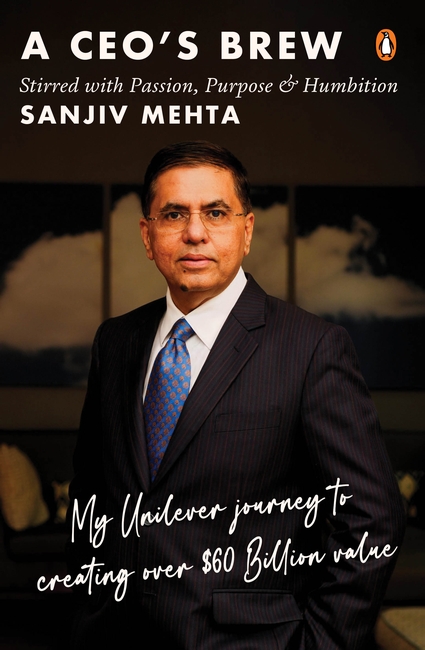

The CEO Who Wrote the Cheque Back: Sanjiv Mehta Launches A CEO’s Brew, an unvarnished India playbook for growth, ethics and nation-building at scale
A rare leadership story from the former Hindustan Unilever Chairman & MD who doubled down on performance and principle — from voluntarily returning “unearned” GST gains to creating measurable, on-ground impact across water, sanitation, livelihoods and inclusion.
In an era when “purpose” is too often a slogan and “governance” a compliance checkbox, Sanjiv Mehta is one of the few corporate leaders with a defining moment that cuts through cynicism: when GST rates changed, Hindustan Unilever decided to return “unearned” benefit to the Government of India even though the law did not explicitly require it, first offering ₹59.94 crore, and later ₹118.9 crore once workings were revised. The then Finance Minister Arun Jaitley, Mehta recalls, said: “I can’t think of many companies other than HUL…” who would do that.
That decision is one of the headline stories in Mehta’s new book, A CEO’s Brew: Stirred with Passion, Purpose and Humbition, My Unilever Journey to Creating over $60 Billion Value, launching now as a candid, high-stakes account of what it takes to build a “high-performing” enterprise in India without compromising on trust.
Why this launch matters now
India is entering a decisive decade for consumption, competitiveness, climate resilience and jobs. Mehta is not commenting from the sidelines he helped shape the modern India growth narrative from the inside: as the “outsider” CEO brought in to lead HUL in 2013 (after 21 years overseas), as Executive Vice President and Head of Unilever South Asia, later becoming President of Unilever South Asia and a member of Unilever’s global executive board (ULE)—the first incumbent HUL CEO to sit on that body.
The performance record that makes this interview worth commissioning
Under Mehta’s leadership arc, HUL’s decade is framed in hard numbers and global comparisons:
- Market cap rose from ~₹1,00,793 crore (2012–13) to ~₹6,01,202 crore (2022–23); and on the day he demitted office (26 June 2023), HUL stood at ~₹6,23,135 crore—making it the fifth most valuable company in India and, in Mehta’s telling, more valuable than multiple global FMCG majors.
- Margins expanded sharply across the decade (including 840 bps improvement over ten years even with post-COVID inflation pressures).
- The transformation narrative is inseparable from big-bet operational shifts data-led decision making, manufacturing network transformation and “future-ready” supply chains built under the “Reimagine HUL” umbrella.
And it’s not an India-only story. Before returning home, Mehta had already built a reputation as a “battle-hardened” CEO across volatile markets Bangladesh, the Philippines and the North Africa & Middle East region including steering through the Arab Spring.
What he’s done for India beyond the balance sheet
Mehta’s sharpest differentiator is that he treats national interest as strategy, not philanthropy captured in the principle he repeats: “what is good for India is good for HUL.”
During his tenure, HUL-backed interventions described in the book include:
- Water security at scale: via the Hindustan Unilever Foundation’s watershed work water potential of ~2.6 trillion litres created across ~14,000 villages (as described in the manuscript).
- Women’s livelihoods: expansion of Project Shakti, with Mehta describing a decade that added ~1,40,000 women entrepreneurs (taking the network to ~1,90,000 “Shakti Ammas”) and building a business of significant scale.
- Urban sanitation with measurable outcomes: the “Suvidha” community hygiene centres in urban slums 20+ centres, ~80,000 registered users, ~5,00,000 people getting access, 100+ million litres of water saved, and a reported 44% reduction in diarrhoea incidence in the local community after access.
- Climate & plastic action: 97% reduction in manufacturing carbon emissions vs a 2008 baseline, plus collecting more plastic waste across India than used in product packaging (as described).
- Building inclusive workplaces (with outcomes, not rhetoric): women in management rising from 18% (2013) to 40%+ by March 2023, alongside specific programmes such as the “losing no mother” initiative and frontline sales inclusion efforts.
Leadership under pressure: COVID as a case study editors will want
Mehta’s COVID chapter is not corporate nostalgia it is an operational, people-first crisis playbook. HUL’s workplace management is described as becoming a benchmark for industry best practices, adopted across Unilever geographies.
A leadership principle repeated in the book: “If we look after our people, they will look after our business.”
And in March 2020, HUL moved early on remote working—“as a market leader… set the tone ahead of the market.”
The national lens: from CEO to policy-shaper
Mehta’s India impact extends into thought leadership and institution-building. He writes about serving as President of FICCI (2022) and driving India@100, a roadmap for India’s centenary ambitions toward 2047 an initiative he says drew inputs from 200+ CXOs, and for which Prime Minister Narendra Modi agreed to write the foreword.
He also describes launching the Centre for Sustainability Leadership at FICCI (in partnership with HUL) to help member companies and SMEs start their sustainability journeys.
Editor’s note: Why you should speak to Sanjiv Mehta now
This is not a “CEO memoir” pitch. It’s an India leadership assignment with multiple commissioning angles:
- Ethics as strategy: the GST “unearned income” story and the moral calculus behind it.
- How to win in India without averaging India: leading a mega-business in “many Indias” (and what most global CEOs still miss).
- Purpose with measurement: sanitation, water security, livelihoods, climate—impact with numbers.
- Crisis leadership: Arab Spring, GST disruption, COVID—how to lead without panic and without spin.
- “Humbition” as a leadership doctrine: Mehta frames his philosophy as ambition grounded in humility—“at the intersection… I call this Humbition.”
Mehta notes he has been invited by global boards to speak on the “India Story” and what made HUL succeed in India—making him a rare executive who can connect boardroom performance, consumer behaviour, policy realities and nation-building in one conversation.
About Sanjiv Mehta
Sanjiv Mehta served as CEO and later Chairman & Managing Director of Hindustan Unilever and held regional responsibility as Executive Vice President and Head of Unilever South Asia; he later became President of Unilever South Asia and joined Unilever’s global leadership executive (ULE) while still leading HUL.
He also served as President of FICCI (2022) and drove the India@100 initiative.
Across his tenure, he received multiple leadership recognitions and notes being inducted into the ICAI Hall of Fame, among other honours.