Books
3000 MILES TO FREEDOM – THE TRUE STORY OF ONE INDIAN PRISONER OF WAR AGAINST THE JAPANESE EMPIRE M.M. Pillai
Captivity is not an option. There is only one thing to do: escape.
3000 Miles to Freedom is the remarkable story of what followed: a journey across Japanese-held Southeast Asia, through Malaya, Siam and Burma, towards India. While prisoners were being marched through a wrecked Singapore, Mark picked up two discarded books—an atlas and an anthology of First World War escape stories
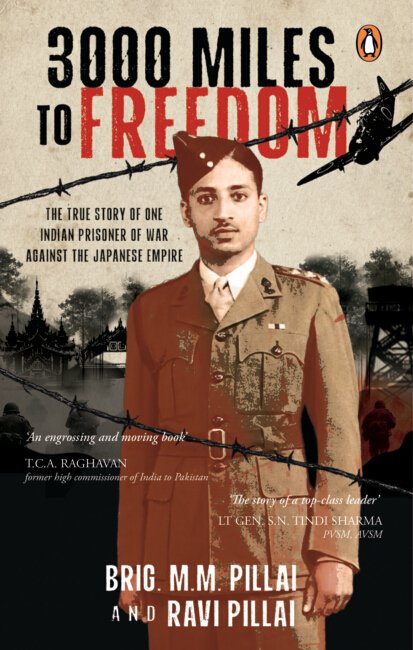

Untold Courage: The True Story of an Indian Prisoner of War Against the Japanese Empire
It’s 1942. Singapore has fallen to the Japanese. For Allied prisoners, the message is blunt: escape is punishable by death. Lieutenant M.M. “Mark” Pillai of the Royal Bombay Sappers and Miners reaches a different conclusion. Captivity is not an option. There is only one thing to do: escape.
3000 Miles to Freedom is the remarkable story of what followed: a journey across Japanese-held Southeast Asia, through Malaya, Siam and Burma, towards India. While prisoners were being marched through a wrecked Singapore, Mark picked up two discarded books—an atlas and an anthology of First World War escape stories. An engineer by training, he turned escape into a problem to be solved: studying routes, rivers and mountain passes, committing alternatives to memory, building his endurance and hardening his feet by walking barefoot over stones and gravel inside the camp. The plan had to live largely in his head.
On 6 May 1942, Mark left the camp with Dr Natarajan and V. Radhakrishnan. What followed was messy, improvised and sometimes absurd: goods trains, buses, ferries, country boats, river craft and long stretches on foot. They travelled under false identities, negotiated permits from Japanese authorities and slept in cockroach-infested brothels. At Ranong, Mark even spent an afternoon grinding masalas in the kitchen of the Japanese consul’s wife while trying to win her help.
It worked.
There was little romance in the physical reality. At one point, the three had just two rupees and a few paise between them. For a period, they ate on alternate days; Mark once marched close to 30 miles on an empty stomach before collapsing into uncontrollable shivering. Yet again and again, strangers—shopkeepers, labourers, traders, fishermen, villagers and families, often with very little themselves—kept them moving with food, shelter, information or money.
hree months and two days after leaving Singapore, Mark and Radhakrishnan reached Fort White on the Indian border. Barefoot, bearded, skeletal and dressed in faded shirts and dhotis, they were challenged by an Indian patrol. The Sikh havildar found Mark’s claim that he was an Army officer difficult to believe. Mark’s response was less than diplomatic. But an hour later, they were inside an Indian Army camp.
They were free.
Their arrival also brought first-hand intelligence from territories about which Allied headquarters had received little reliable information after the fall of Singapore. Both men were debriefed at Army Headquarters in Delhi and subsequently awarded the Military Cross.
Contextualised and expanded by Ravi Pillai, Mark Pillai’s son, 3000 Miles to Freedom draws on the notes Mark made after reaching Delhi in 1942, extracts from his Army Headquarters debriefing and years of conversations between father and son. Ravi brings historical, geographical and political context to the account while deliberately preserving his father’s observational first-person voice at its core. The book is therefore both an extraordinary wartime escape story and a deeply personal act of preservation—bringing to light an episode Mark himself rarely spoke about and never made much of.
Perhaps the most unusual thing is what Mark did with the story afterwards. Very little. The man who crossed nearly 3,000 miles of occupied territory simply got on with the rest of his life.